

Knowledge
Professor Sadie Morgan OBE: ‘Let’s bring a bit of joy back in our lives’
LSA alumnus wins at Built Environment Awards 2026
Job opportunity: Caretaker
Dezeen School Show: LSA MArch
LSA Part 0 leads shortlisted at the NLA Awards
The LSA Award 2026 Winner: Caspar Barker
LSA Student Highly Commended at Architects for Health Student Design Awards
LSA student named a finalist for the Test of Time Awards
Architectural Education as a Situated Practice and the Little Free Library
From Crisis to Opportunity: Reframing the Future for Architecture Graduates
Architectural Education as a Situated Practice | London Festival of Architecture
LSA Student shortlisted for the AJ New Talent Award
If Only We Will: Degree Show 2026
Belonging by Design: A Collective Act | London Festival of Architecture
Design Think Tank: Call for Practice Briefs
LSA International Field Trip 2026: Belgium
LSA Representation in the AJ Small Projects 2026 shortlist
LSA Student Placement with Ryder Architecture
Alumni Case Study: Elliott Wang
Open Evening 1 April 2026
Design For Life returns this February
Call for Abstracts: Learnings/Unlearnings Conference
Part 0 Lead wins at Inspire Future Generations Awards
Applications open for MArch in Designing Architecture
The University of the Built Environment appoints new Professors
Get to know Lee Ivett
Open Evening 20 January 2026
LSA faculty nominated for Inspire Future Generations Awards
Yang Yang Chen shortlisted for Young Talent award
LSA Part 0 co-leads shortlisted for Inspire Future Generations Awards
LSA tutor is RIBA House of the Year finalist
Lee Ivett Open Evening Speech
Hugh Strange Architects: House of the Year 2025 shortlist
Lee Ivett starts as Head of School
LSA tutor wins Young Architect of the Year 2025
Open Evening 19 November 2025
AJ Student Prize | Postgraduate Winner: Amy Wilkinson
Hugh Strange Architects Shortlisted for RIBA Stirling Prize 2025
‘Design for Life’ returns this November – Part 4
Lee Ivett appointed as Head of School at London School of Architecture
George Moldovan shortlisted for 2025 Structural Timber Awards
‘A Seat at the Table’ Summer Show 2025
University of the Built Environment
OPEN DAY 11 June 2025
Future Skills Think Tank
LSA and UCEM merge
Future Skills Think Tank
Festival of the Future
Sixty years on from the London County Council: legacy, impact, learning
Dr Neal Shasore stepping down as Head of School and Chief Executive of the London School of Architecture (LSA) in February 2025
Load moreDesign Think Tanks – Adaptive Typologies

Final Courtyard View
London’s population is growing rapidly, and thousands of new homes need to be built to accommodate this growth. However, the common approach of mass-produced ‘one-size-fits-all’ flats in identikit developments ignores the complex needs of the culturally and socially diverse mix of people who call the city home.
Adaptive Typologies are posing the question: how can we build at the necessary densities to house the population, while making these places inclusive, sustainable and conducive to a sense of community?
Our investigation began with a study of how density is being addressed currently. We visited three dense housing developments in London and interviewed residents about their experiences of living there. One of the most pertinent points that arose was that despite living among many people, residents rarely knew their neighbours. We came to refer to this condition as The Density Paradox.
Through analysing the residents’ journeys around these precedent buildings, we found that all three had compromised circulation spaces to optimise and maximise unit arrangements. The journey from the street to the flat tended to consist of vacuous lobbies, lifts and narrow corridors with no natural light or indication of the life behind anonymous closed doors. Circulation spaces were treated as purely transitory spaces for passing through swiftly, rather than spaces to enjoy or display signs of ownership. If there was any other common space, this was poorly considered and separated from the places residents naturally pass through.

Axonometric of Site
A site in London on the Old Kent Road was chosen as the testing ground for our hypothesis. An Area Action Plan currently in development is proposed to radically transform the district from a low-rise, low-density largely industrial zone into a dense urban area, with thousands of new homes proposed over the next twenty years.
Barratt Homes have optimistically noted that ‘the extension will provide a significant increase to the area’s historically low property values’, which is great news for the developers and landowners, but less so for existing residents benefiting from relatively low rental values.
A demographic study of the local area revealed the rich diversity of cultures, backgrounds and ages of residents, such as groups of up to 11 undocumented migrants living in one flat. The typical offer of standardised apartments found in many new developments is inadequate to serve the complex needs of residents that don’t fit the criteria of the developer’s target market.
Our response has been to develop five distinct typologies that explore different approaches to achieving density.

Typology 1
Typology 1
A 19-storey tower at the north-west corner of the site achieves density through a tight floor plan coupled with height. A void cuts down the building through the common areas allowing the sharing of space vertically through the building as well as horizontally.

Typology 2
Typology 2
To the north, a block of live/work units achieves density through narrow unit plans. A portion of double-height space helps to bring light deep into the plan while giving it a sense of generosity.

Typology 3
Typology 3
The block to the west achieves density through eight-bedroom units that can allow living spaces and bathrooms to be fewer but larger, responding to the need for shareable spaces for groups of migrants, students and young professionals.
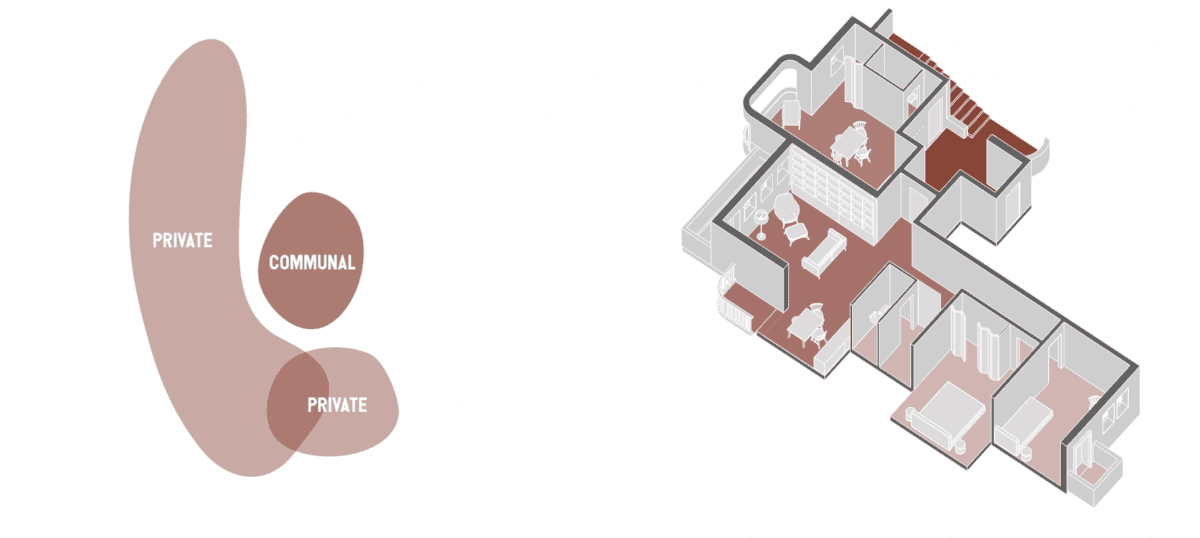
Typology 4
Typology 4
Achieving density by incorporating a deep plan, the block to the east takes an intimate approach to the sharing of common space, with front doors arranged in clusters of three on either side of a landing.

Typology 5
Typology 5
The largest block facing onto the Old Kent Road reimagines the mansion block typology, with an extra deep plan made possible by light wells that pull light into its depth. Common spaces ooze around the units, allowing a more direct connection to them and an invitation to inhabit the space outside one’s front door.

Plan of the site showing the different typologies
The five typologies form separate blocks on the site, creating smaller sub-communities within the overall community of the scheme. This gives dense buildings a more comprehensible human scale. The blocks are arranged around a central courtyard which is where all of these smaller communities come together alongside industrial and workspace uses on the ground floor.
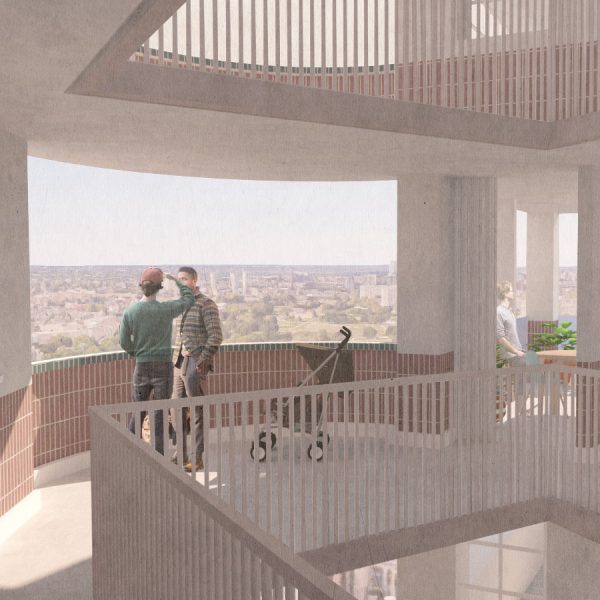
Triple height common spaces in the tower opening up towards the city
The proposal achieves a density of 1,910 people per hectare, well above the target set out in the Area Action Plan of 1,000 people per hectare. In addition to being able to provide much-needed homes for a growing population, the scheme delivers a mix of unit sizes ranging from studio flats to eight-bedroom co-living flats, a variety of outdoor amenity spaces at every level from ground floor to roof and not a single internal corridor without natural light or ventilation.

A landing area of Typology 4 shared between 2-3 units

Live work units opening out onto the shared deck
Adaptive typologies is led by Angie Jim Osman from Allies and Morrison and Rafael Marks from Penoyre & Prasad. Students: Seyi Adewole, Cristina Gaidos, Alice Hardy, Pierre Longhini, Tim Rodber, Nelli Wahlsten.