

Knowledge
LSA alumnus wins at Built Environment Awards 2026
Job opportunity: Caretaker
Dezeen School Show: LSA MArch
LSA Part 0 leads shortlisted at the NLA Awards
The LSA Award 2026 Winner: Caspar Barker
LSA Student Highly Commended at Architects for Health Student Design Awards
LSA student named a finalist for the Test of Time Awards
Architectural Education as a Situated Practice and the Little Free Library
From Crisis to Opportunity: Reframing the Future for Architecture Graduates
Architectural Education as a Situated Practice | London Festival of Architecture
LSA Student shortlisted for the AJ New Talent Award
If Only We Will: Degree Show 2026
Belonging by Design: A Collective Act | London Festival of Architecture
Design Think Tank: Call for Practice Briefs
LSA International Field Trip 2026: Belgium
LSA Representation in the AJ Small Projects 2026 shortlist
LSA Student Placement with Ryder Architecture
Alumni Case Study: Elliott Wang
Open Evening 1 April 2026
Design For Life returns this February
Call for Abstracts: Learnings/Unlearnings Conference
Part 0 Lead wins at Inspire Future Generations Awards
Applications open for MArch in Designing Architecture
The University of the Built Environment appoints new Professors
Get to know Lee Ivett
Open Evening 20 January 2026
LSA faculty nominated for Inspire Future Generations Awards
Yang Yang Chen shortlisted for Young Talent award
LSA Part 0 co-leads shortlisted for Inspire Future Generations Awards
LSA tutor is RIBA House of the Year finalist
Lee Ivett Open Evening Speech
Hugh Strange Architects: House of the Year 2025 shortlist
Lee Ivett starts as Head of School
LSA tutor wins Young Architect of the Year 2025
Open Evening 19 November 2025
AJ Student Prize | Postgraduate Winner: Amy Wilkinson
Hugh Strange Architects Shortlisted for RIBA Stirling Prize 2025
‘Design for Life’ returns this November – Part 4
Lee Ivett appointed as Head of School at London School of Architecture
George Moldovan shortlisted for 2025 Structural Timber Awards
‘A Seat at the Table’ Summer Show 2025
University of the Built Environment
OPEN DAY 11 June 2025
Future Skills Think Tank
LSA and UCEM merge
Future Skills Think Tank
Festival of the Future
Sixty years on from the London County Council: legacy, impact, learning
Dr Neal Shasore stepping down as Head of School and Chief Executive of the London School of Architecture (LSA) in February 2025
PART 0 WINS INSPIRE FUTURE GENERATIONS AWARD FOR FURTHER EDUCATION/HIGHER EDUCATION
Load moreDesign Think Tank: Call for Practice Briefs
The London School of Architecture (LSA) Design Think Tank (DTT) module generates creative design propositions informed by rigorous research aimed at addressing tangible built environment issues in London, during a 14 week module for year 1 MArch students.
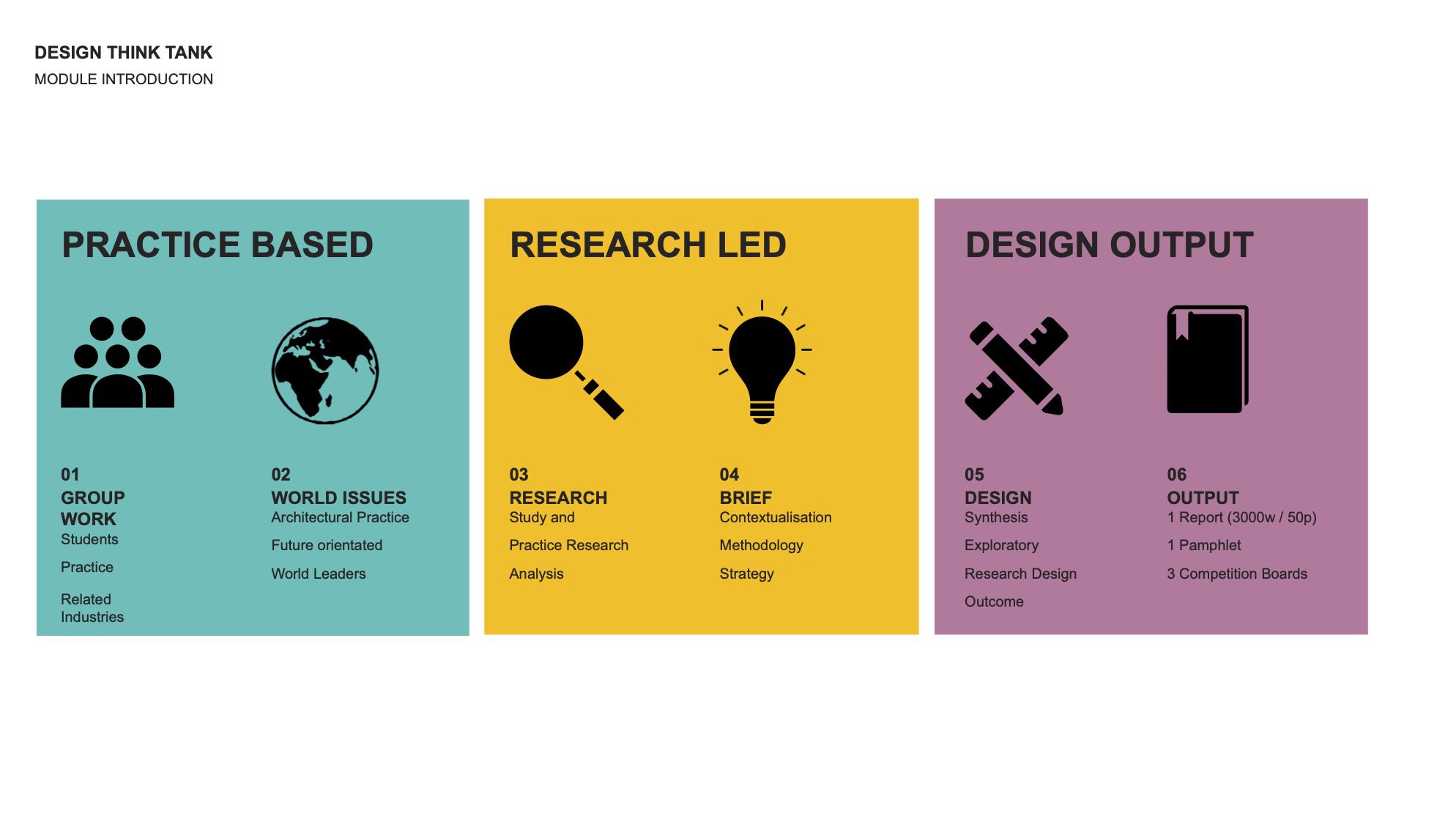
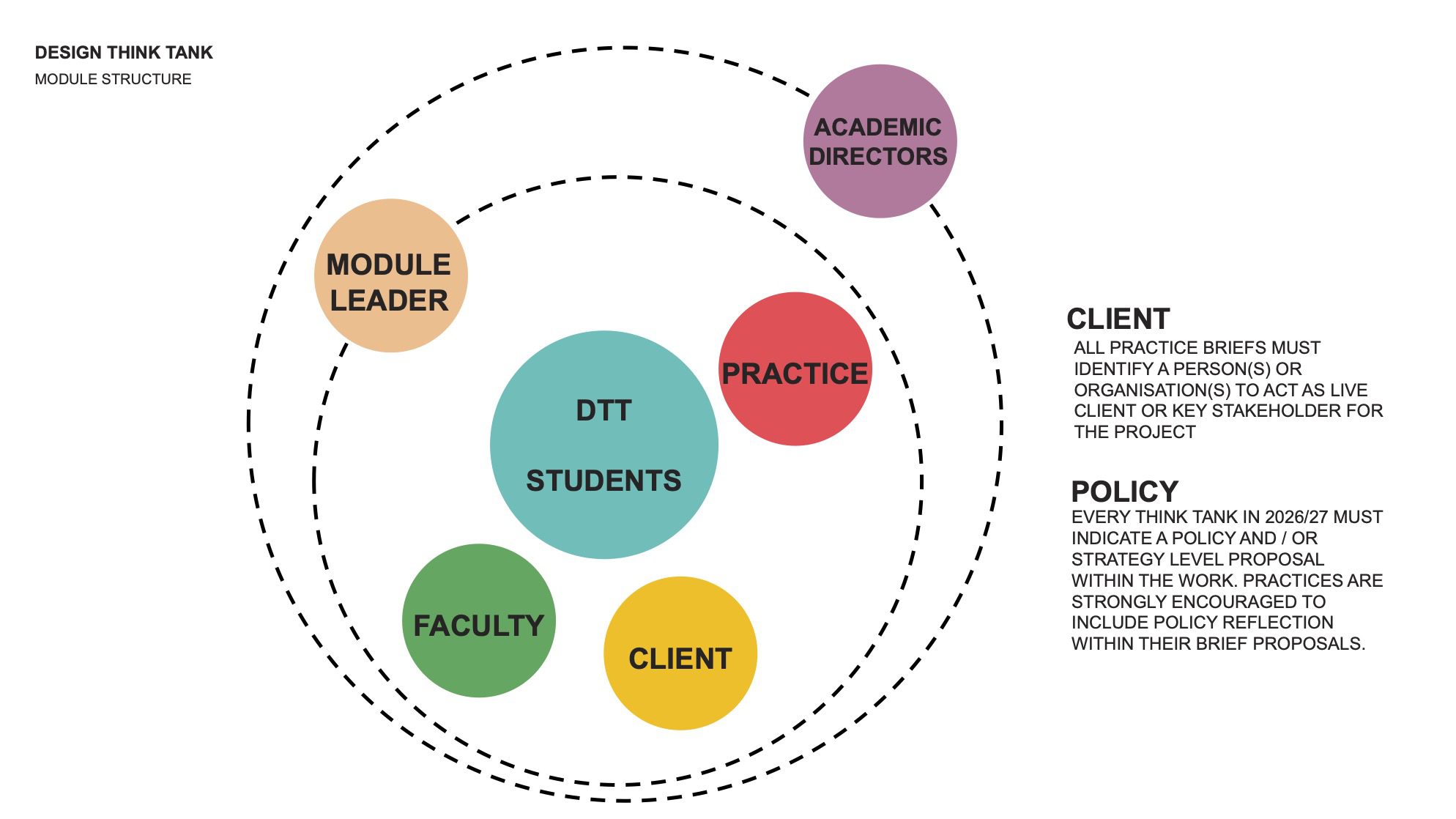
Each year the LSA selects a shortlist of DTT topics to be studied from a long list of suggestions made by the LSA Practice Network. The study topics suggested are ones that require urgent consideration in contemporary practice, revolving around innovative thinking and design proposals that will generate significant social and environmental progress and beneficial urban change. Students elect to work on one of the shortlisted study topics in collaborative groups, led by practitioners from the practice that suggested the DTT study topic. Each DTT comprises 6 students and one LSA Design Tutor. LSA Faculty work with the DTT leaders to guide and support students through the research and design process.
The LSA is seeking to run Design Think Tanks for the 2026-27 incoming cohort of Part 2 students. This year, we continue to explore the tension between intensely local analysis with the global issues and crises facing humanity and the planet. Collectively, we seek to imagine how radical ideas in local governance can contribute to meet these much wider challenges to secure more sustainable futures. Each Design Think Tank group will work with an active stakeholder.
The research emerging from the Design Think Tanks will be codified in digestible reports that can be used by local partners, ranging from London Boroughs of Newham, Barking and Dagenham, Havering, Greenwich and Bexely, to institutions of civil society and community groups. As the LSA welcomes its twelfth cohort, colleagues will notice that some themes have been explored to varying degrees in previous years. We strongly encourage practice and students to build on, challenge, and develop work undertaken by their predecessors and indeed from others in the sector. How can the LSA be ever more radical and disruptive of the status quo?
Each year, the LSA selects a shortlist of DTT topics to be studied from a long list of proposals made by the LSA Practice Network. We have suggested some initial themes below – we are seeking the energy of our colleagues in practice to evolve ambitious, thoughtful proposals and look forward to your suggestions.
CLIENT: All practice briefs must identify a person(s) or organisation(s) to act as a live client or key stakeholder for the project.
POLICY: Every Think Tank in 2026/27 must indicate a policy and/or strategy level proposal within the work. Practices are strongly encouraged to include policy reflection within their brief proposals.
SITE: 2026/27 Design Think Tanks will be based on sites from the Thames Barrier eastwards, up to 2km north or south of the river Thames in the London Boroughs of Newham, Barking and Dagenham, Havering, Greenwich and Bexley.
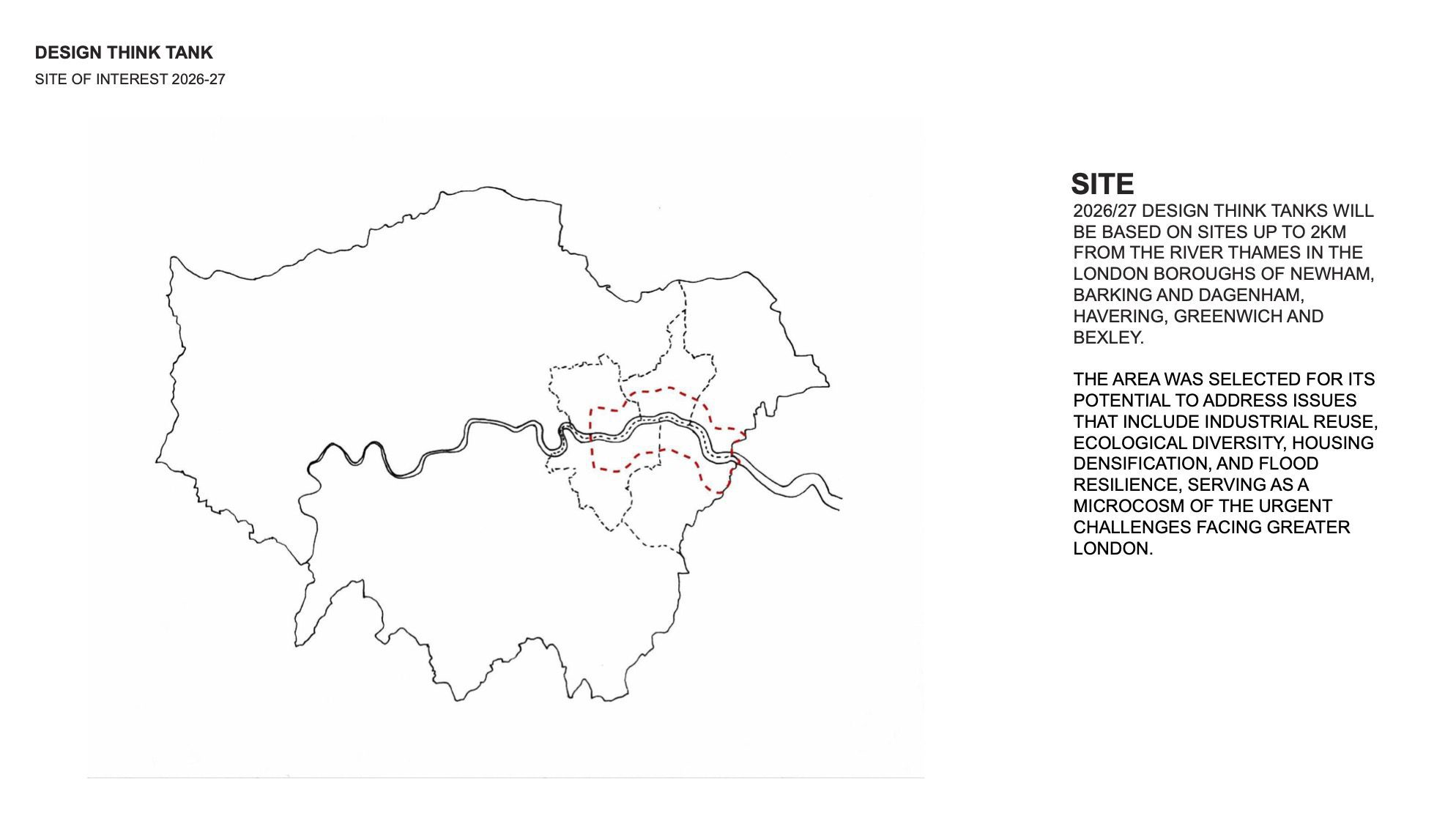
The area was selected for its potential to address issues that include industrial reuse, ecological diversity, housing densification, and flood resilience, serving as a microcosm or the urgent challenges facing greater London.
As a school, we have interest in projects which facilitate Decarbonisation – the attention to urgent climate emergency through design, Decolonisation– critique of colonial/power structures past and present, De-standardisation – mitigating standards that are exclusionary to different modes of being. We invite your propositions for a Design Think Tank brief on a theme relevant to your practice.
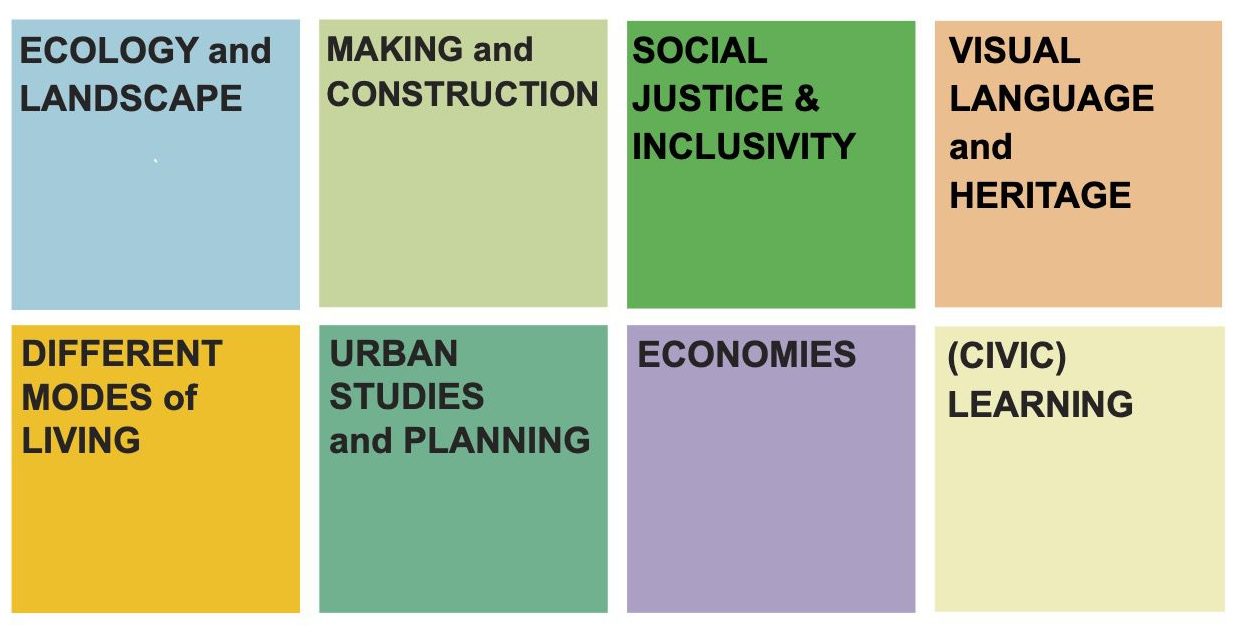
There is an expectation that your research will engage with an active client/stakeholder, Bioregional design and the Policy context relevant to this area, from global to local. This brief may explore, but is not limited to, the following themes:
Envisaged as part of practice research development and a collaboration of reciprocal knowledge exchange between industry and academia the DTT practice time is not remunerated by the LSA. However, practices that are explicitly not for profit or have less than 5 FT staff may be enquire about an honorarium upon submission of their proposal. Practices are also encouraged to familiarise themselves with current government policy in relation to tax relief for R&D and social value related activity.
Please submit your practice brief proposal using this FORM.
We look forward to your proposals by 23/06/2026. A Design Think Tank Q&A for practices and stakeholders will be held at the LSA on the 1st June from 6.30 to 8pm.
Please contact Design Think Tank Module leader Dr Nicola Antaki for more information: n.antaki@ube.ac.uk
FAQs
What is a Design Think Tank (DTT)?
A Design Think Tank is a research-led design module within the LSA’s Part 2 programme, where students work collaboratively with practices and stakeholders to explore real-world challenges and produce design-led research outputs.
How many students are involved?
Each DTT consists of 6 students, supported by one LSA Design Tutor and wider faculty input.
When does the module run?
The module runs from 30 November to early March, with final submission on 8 March.
What is expected from practices?
Practices are invited to:
- Propose a brief aligned with the DTT themes
- Engage with students weekly with consistent members of staff
- Shape the brief in advance through a small number of meetings with LSA and other practices
- Identify a live client or stakeholder for the project
What do students produce?
Students generate a practice-based research and design output, typically including:
- A design report (approx. 50 pages)
- A 2000-word reflective statement
- Three A1 presentation boards
- An A5 pamphlet for dissemination
What kind of topics are suitable?
Topics should engage with:
- Urgent real-world challenges and policy contexts
- Themes such as decarbonisation, decolonisation, and de-standardisation
- Issues including ecology, housing, infrastructure, social justice, and economies
- Please refer to the DTT information for practices PDF
Where are projects based?
Projects focus on sites eastwards of the Thames Barrier, within 2km north and south of the River Thames, in East and South-East London boroughs including Newham, Barking & Dagenham, Greenwich, and Bexley. See map on PDF.
Is participation paid?
Participation is not typically remunerated, as the DTT is framed as a form of collaborative research and knowledge exchange. However, not-for-profit practices or those with fewer than 5 full-time staff may enquire about an honorarium.
What is the benefit for practices?
Practices benefit from:
- Focused research aligned with their interests
- Collaboration with students and academia
- Outputs that can inform policy, strategy, or future projects
- Engagement with live stakeholders and local contexts