

Knowledge
Professor Sadie Morgan OBE: ‘Let’s bring a bit of joy back in our lives’
LSA alumnus wins at Built Environment Awards 2026
Job opportunity: Caretaker
Dezeen School Show: LSA MArch
LSA Part 0 leads shortlisted at the NLA Awards
The LSA Award 2026 Winner: Caspar Barker
LSA Student Highly Commended at Architects for Health Student Design Awards
LSA student named a finalist for the Test of Time Awards
Architectural Education as a Situated Practice and the Little Free Library
From Crisis to Opportunity: Reframing the Future for Architecture Graduates
Architectural Education as a Situated Practice | London Festival of Architecture
LSA Student shortlisted for the AJ New Talent Award
If Only We Will: Degree Show 2026
Belonging by Design: A Collective Act | London Festival of Architecture
Design Think Tank: Call for Practice Briefs
LSA International Field Trip 2026: Belgium
LSA Representation in the AJ Small Projects 2026 shortlist
LSA Student Placement with Ryder Architecture
Alumni Case Study: Elliott Wang
Open Evening 1 April 2026
Design For Life returns this February
Call for Abstracts: Learnings/Unlearnings Conference
Part 0 Lead wins at Inspire Future Generations Awards
Applications open for MArch in Designing Architecture
The University of the Built Environment appoints new Professors
Get to know Lee Ivett
Open Evening 20 January 2026
LSA faculty nominated for Inspire Future Generations Awards
Yang Yang Chen shortlisted for Young Talent award
LSA Part 0 co-leads shortlisted for Inspire Future Generations Awards
LSA tutor is RIBA House of the Year finalist
Lee Ivett Open Evening Speech
Hugh Strange Architects: House of the Year 2025 shortlist
Lee Ivett starts as Head of School
LSA tutor wins Young Architect of the Year 2025
Open Evening 19 November 2025
AJ Student Prize | Postgraduate Winner: Amy Wilkinson
Hugh Strange Architects Shortlisted for RIBA Stirling Prize 2025
‘Design for Life’ returns this November – Part 4
Lee Ivett appointed as Head of School at London School of Architecture
George Moldovan shortlisted for 2025 Structural Timber Awards
‘A Seat at the Table’ Summer Show 2025
University of the Built Environment
OPEN DAY 11 June 2025
Future Skills Think Tank
LSA and UCEM merge
Future Skills Think Tank
Festival of the Future
Sixty years on from the London County Council: legacy, impact, learning
Dr Neal Shasore stepping down as Head of School and Chief Executive of the London School of Architecture (LSA) in February 2025
Load moreTeaching design at the LSA — Holly Harrington
We spoke to the Design Tutors delivering our programme at the LSA and asked about their design methodology and ethos as professional designers and architects. Holly Harrington is a First Year Design Tutor at the LSA and architect at PDP. Here’s what she had to say.

My view of the architect and our role has shifted and changed over the years as I progressed through education and now in practice. I have mostly worked on large complex projects and the role of ‘architect-as-collaborator’ is evident with large teams and a multitude of concerns.
When I began studying I became aware of the lingering stereotypical negative image of the past architect in an ivory tower, sometimes known to be arrogant, and dictatorial. I see the design process as extremely collaborative so this was an image I wanted to get far away from; I am always striving to portray our profession in the collaborative, dynamic and enthusiastic way I see it occurring every day with the various teams I work with, at PDP London, and at the LSA.
The design process for me is trial and error on paper and models to a degree. Each time I always find myself refusing to stop designing until I have explored all the possibilities before I can go back to the brief and assess which option is the most appropriate and exciting. It is an iterative process where a good feedback loop with yourself is exercised. In later design stages, many forget that design still continues and the aim becomes more about solving practical issues whilst still retaining the initial design concept. This is quite tricky when under time pressure, but a crucial skill for a good architect to have. Being a good listener to understand all aspects of a problem is key to enabling collaborative working environments and successful outcomes on projects.
Project 1 — A Sense Of Place, Kentish Town
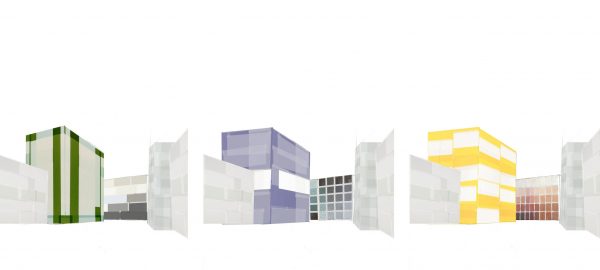
Facade mock-up initial study
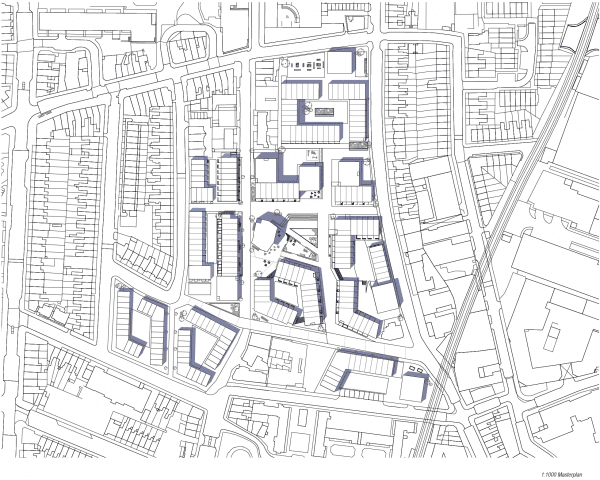
Site plan
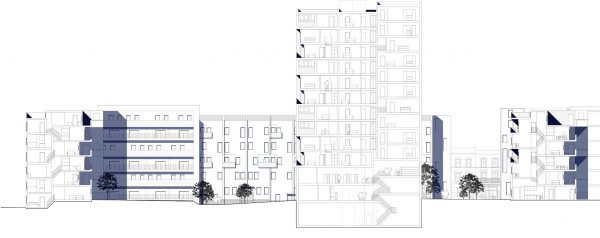
Section
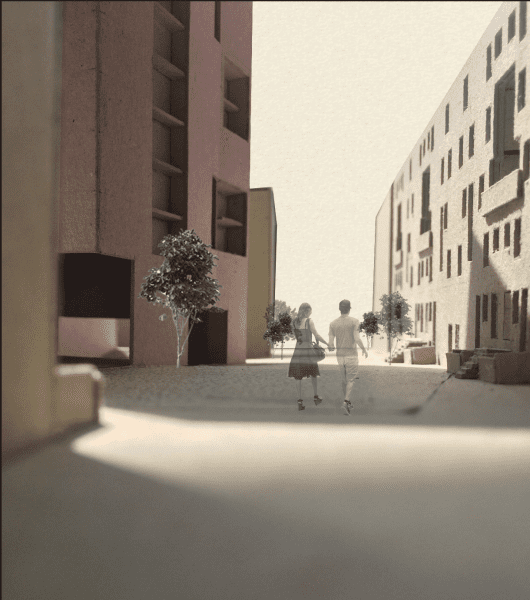

This housing development was part of my Part II portfolio, but still remains a pivotal learning point for me. The brief was strict and very practical aiming to create high-density housing in medium-rise buildings, rehousing social housing tenants and welcoming new residents of all kinds. The proposal aimed to challenge the status quo of many new, similar scale developments which are dropped into existing localities without any connection, or engagement with surrounding communities, and facilities. The development proposed a new urban route through the site with a variety of shared surfaces to guide and delineate ownership which would connect and draw people through the development to a public square with a library and leisure centre. Surrounding housing units are split level, based on the traditional terraced house dimensions and each type has a different feature element to foster a stronger sense of place for residents. The central tower is modular, clad in pink concrete and has a variety of volumes that could be stacked and flipped depending on the required tenure mix. Studios, duplexes and single-storey units within the tower are based on a private rented sector (PRS) model to enable a housing association to provide a variety of homes at affordable rates via leasing. To create something different, exciting yet financially and practically plausible in the current market was a challenging, yet enriching process. And now we are seeing a similar approach being adopted in real life. It has taken a bit of time, but it seems the London Borough of Enfield is following this route using PRS to provide the required affordable housing for its borough.
Project 2 — Cambridge House, Mayfair, London


Sitting back from the busy thoroughfare of Piccadilly, Cambridge House is Grade I listed and one of London’s rare examples of an 18th Century Palladian house built as a ‘Hotel Particulier’ by Matthew Brettingham. The site consists of two adjacent Grade II listed Victorian wing buildings as well as several other unlisted buildings. This project is a challenge on many fronts where design sensitivity, historical understanding and innovation is required. When working with existing buildings we need to respect the history of the existing fabric. However, we also explore the opportunities to bring these important buildings back to life and give them a new lease of life to last for many more years to come. The building itself is a palimpsest of many periods of change and ownership, which is a crucial element of our design going forward where in this most recent transformation we are adding to the layers in the building’s story. These images of the central staircase show the layers of materials, and alterations, as well as our aim to create a narrative in distinguishing existing from new and above from below.