

Knowledge
Professor Sadie Morgan OBE: ‘Let’s bring a bit of joy back in our lives’
LSA alumnus wins at Built Environment Awards 2026
Job opportunity: Caretaker
Dezeen School Show: LSA MArch
LSA Part 0 leads shortlisted at the NLA Awards
The LSA Award 2026 Winner: Caspar Barker
LSA Student Highly Commended at Architects for Health Student Design Awards
LSA student named a finalist for the Test of Time Awards
Architectural Education as a Situated Practice and the Little Free Library
From Crisis to Opportunity: Reframing the Future for Architecture Graduates
Architectural Education as a Situated Practice | London Festival of Architecture
LSA Student shortlisted for the AJ New Talent Award
If Only We Will: Degree Show 2026
Belonging by Design: A Collective Act | London Festival of Architecture
Design Think Tank: Call for Practice Briefs
LSA International Field Trip 2026: Belgium
LSA Representation in the AJ Small Projects 2026 shortlist
LSA Student Placement with Ryder Architecture
Alumni Case Study: Elliott Wang
Open Evening 1 April 2026
Design For Life returns this February
Call for Abstracts: Learnings/Unlearnings Conference
Part 0 Lead wins at Inspire Future Generations Awards
Applications open for MArch in Designing Architecture
The University of the Built Environment appoints new Professors
Get to know Lee Ivett
Open Evening 20 January 2026
LSA faculty nominated for Inspire Future Generations Awards
Yang Yang Chen shortlisted for Young Talent award
LSA Part 0 co-leads shortlisted for Inspire Future Generations Awards
LSA tutor is RIBA House of the Year finalist
Lee Ivett Open Evening Speech
Hugh Strange Architects: House of the Year 2025 shortlist
Lee Ivett starts as Head of School
LSA tutor wins Young Architect of the Year 2025
Open Evening 19 November 2025
AJ Student Prize | Postgraduate Winner: Amy Wilkinson
Hugh Strange Architects Shortlisted for RIBA Stirling Prize 2025
‘Design for Life’ returns this November – Part 4
Lee Ivett appointed as Head of School at London School of Architecture
George Moldovan shortlisted for 2025 Structural Timber Awards
‘A Seat at the Table’ Summer Show 2025
University of the Built Environment
OPEN DAY 11 June 2025
Future Skills Think Tank
LSA and UCEM merge
Future Skills Think Tank
Festival of the Future
Sixty years on from the London County Council: legacy, impact, learning
Dr Neal Shasore stepping down as Head of School and Chief Executive of the London School of Architecture (LSA) in February 2025
Load moreDesign Think Tanks – Metabolic City
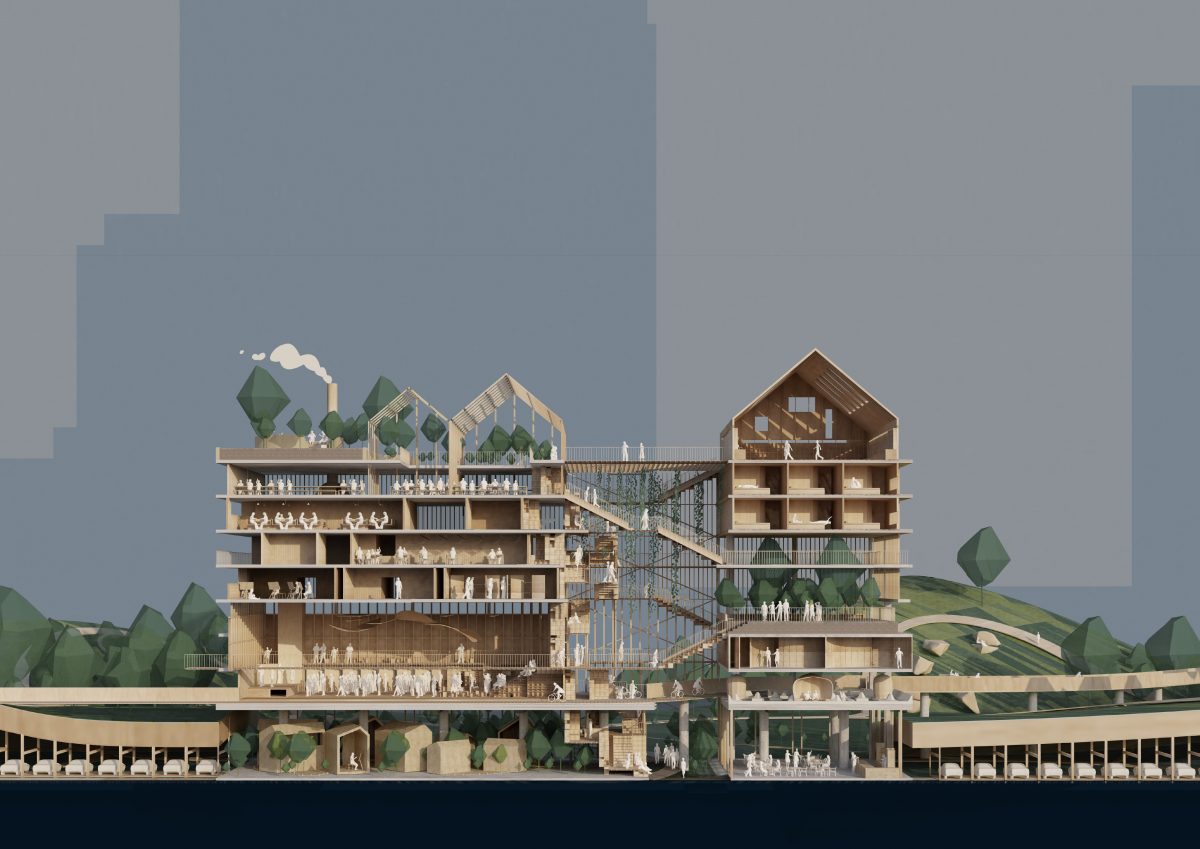
Section cut through the repurposed hotel showing the integrative public commons
London is sick. Pollution, stress, poverty, lengthy commutes and restrictions on council amenities mean that despite the opportunities available to some, many are unable to live well. The project explores ways in which architecture and city design can help to relieve the pressures on the NHS, which we believe to be one of our most important and valuable institutions.
Using North Acton as a case study, the project addresses varying scales from transport infrastructures to street furniture, reimagining everyday objects and spaces as vehicles for change in the city.
We looked to design a system of architecture, public space, infrastructure and street furniture that encourages healthier uses of the city. The focal point of the work is the adaptive reuse of a hotel situated on the A40 in North Acton. The building becomes a new form of urban commons. Part car park, part library, part living room, the building reimagines elements of the everyday, becoming a test bed for new ways of living in the city.
Three demographics were identified, each of which established issues in health and wellbeing that can be addressed through spatial design. These issues were then used as a lens to interrogate the architecture.
Over 40 per cent of children in North Acton are obese or overweight, with obesity costing the NHS an estimated £7 billion per year.
Mental health and loneliness have become nationwide epidemics. In a recent survey, 50 per cent of those aged 65 or over felt detached from civic participation and leisure activities, our built environment compounds these issues.
Finally, exercise participation rates in ethnic minority women are 14 per cent lower than the national average. Can reimagining our transport infrastructure, education spaces and food rituals improve participation rates in marginalised societies?
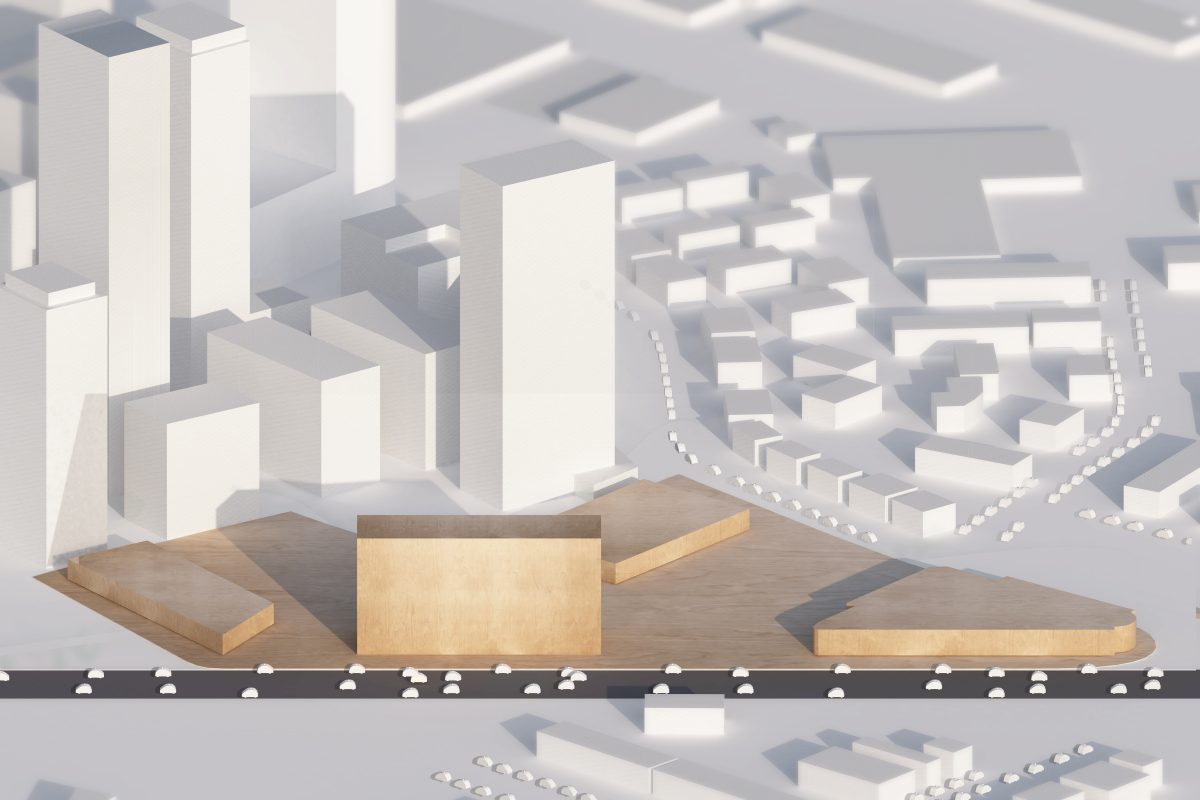
Cars dominate the existing context
A car park is created, taking parked cars off the surrounding suburban streets. The streets can be reclaimed as public space, healthier and happier for all. The car park initially takes enough cars from the road to provide a car-free route between North and West Acton. As the scheme grows in scale, more cars are removed to provide a car-free zone.
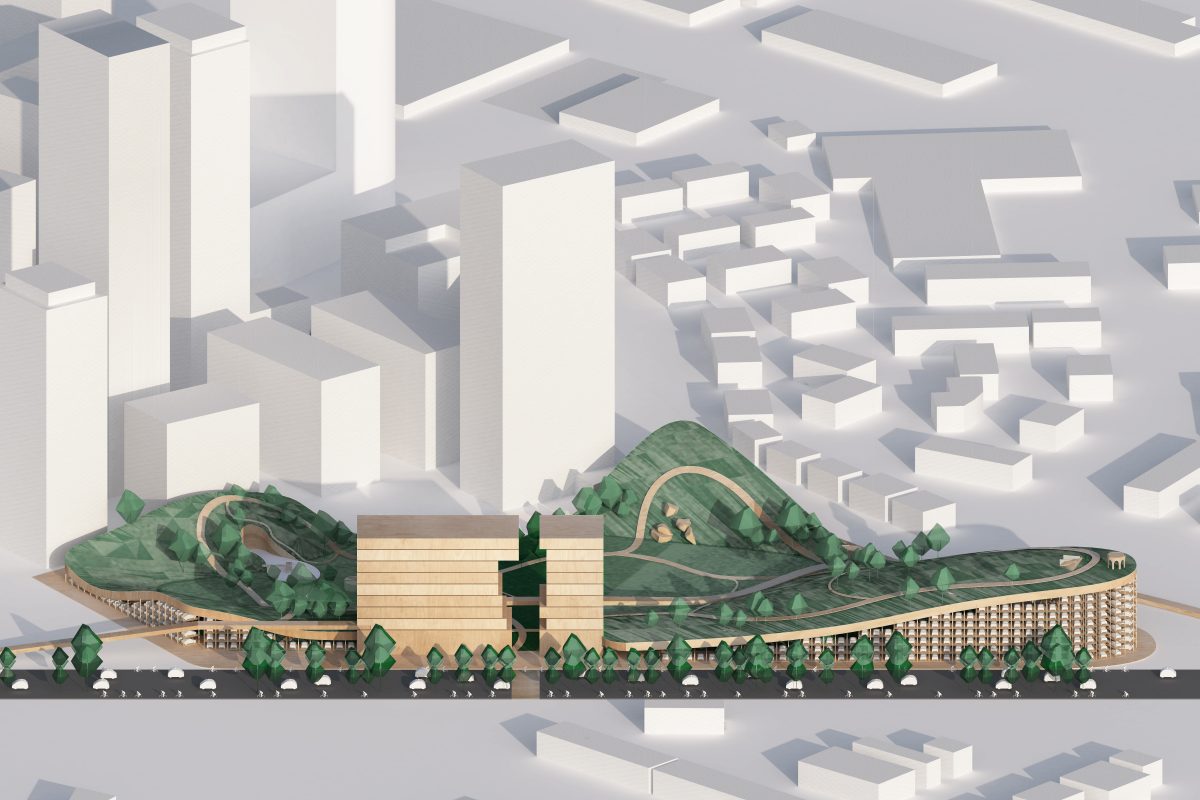
Nature is introduced into the city
A landscape is then ‘draped’ over the car park, creating an undulating parkland in North Acton. The park would act as a productive landscape, providing planting for new ‘wild lanes’ on the surrounding roads. Finally, the existing hotel on the site would be reappropriated as a new form of urban commons.
The elements of a typical street have been examined, reinterpreting their use as infrastructure for a healthy city. A lamppost, a bus stop, a bollard, the crossing, the kerb. By addressing the street typology, our project has the opportunity to reach a demographic of society that is too often forgotten, encouraging a healthy lifestyle for all, not just those who can afford it. Each element aims to provoke and change thought processes that determine the ways in which we use our city.
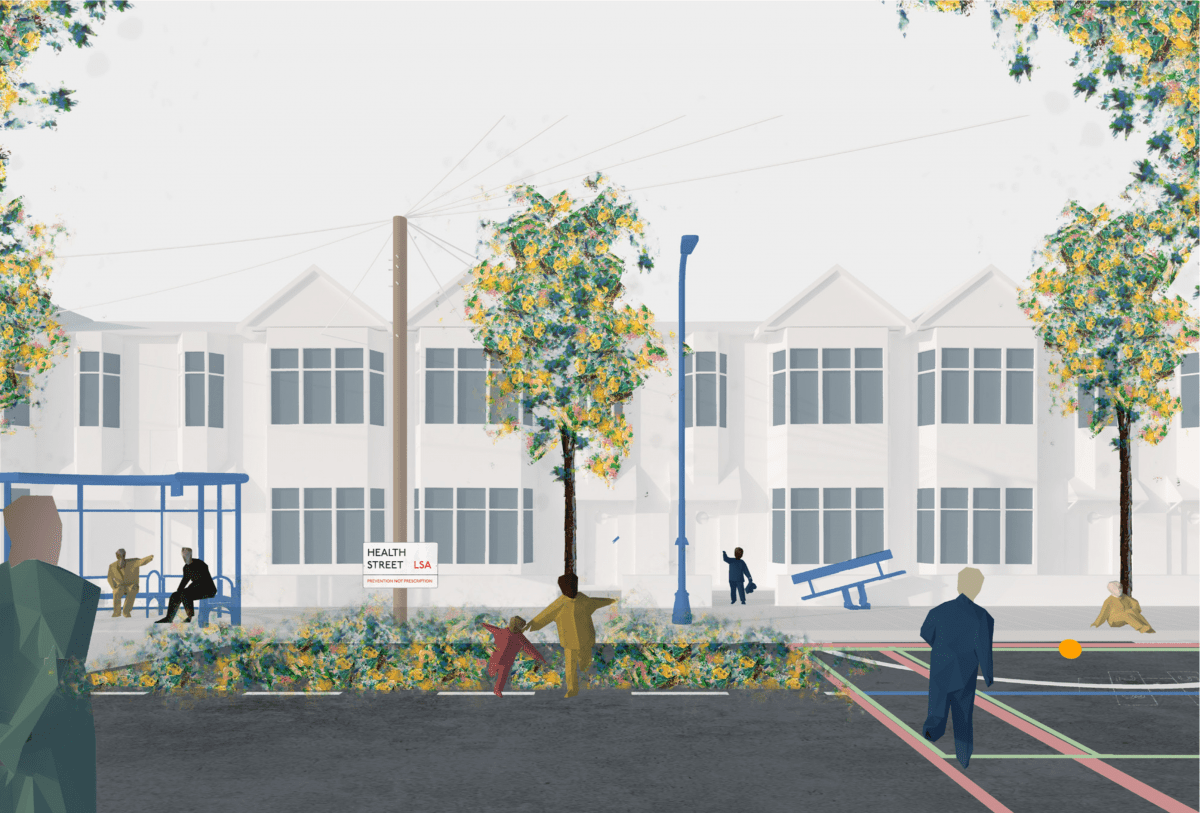
Reclaiming the street
Where society is heavily reliant on the market and state, we will re-establish the commons as fundamental to our society and in doing so increase a sense of shared value and responsibility in the city. This manifests through the building’s programme, which is split into three sections encouraging the sharing of objects, knowledge and experiences.
The ground-floor spaces create low threshold activities. A series of sheds provide workspaces for the local residents. A second space on the ground floor references the kitchen table philosophy established by Maggie’s Centres for cancer patients. Between the two spaces a ‘cut’ through the building encourages movement across the site. With the limited provision of space in homes across London, the ‘cut’ also provides a bank of objects that would be shared within the community. This reinterpretation of the traditional library encourages empathetic connections and a sense of social cohesion.
A common hall provides the space for large-scale events and activities. A miniature forest provides an intense point of nature within the building (contact with nature has been found to have a profound impact on mental health and obesity).
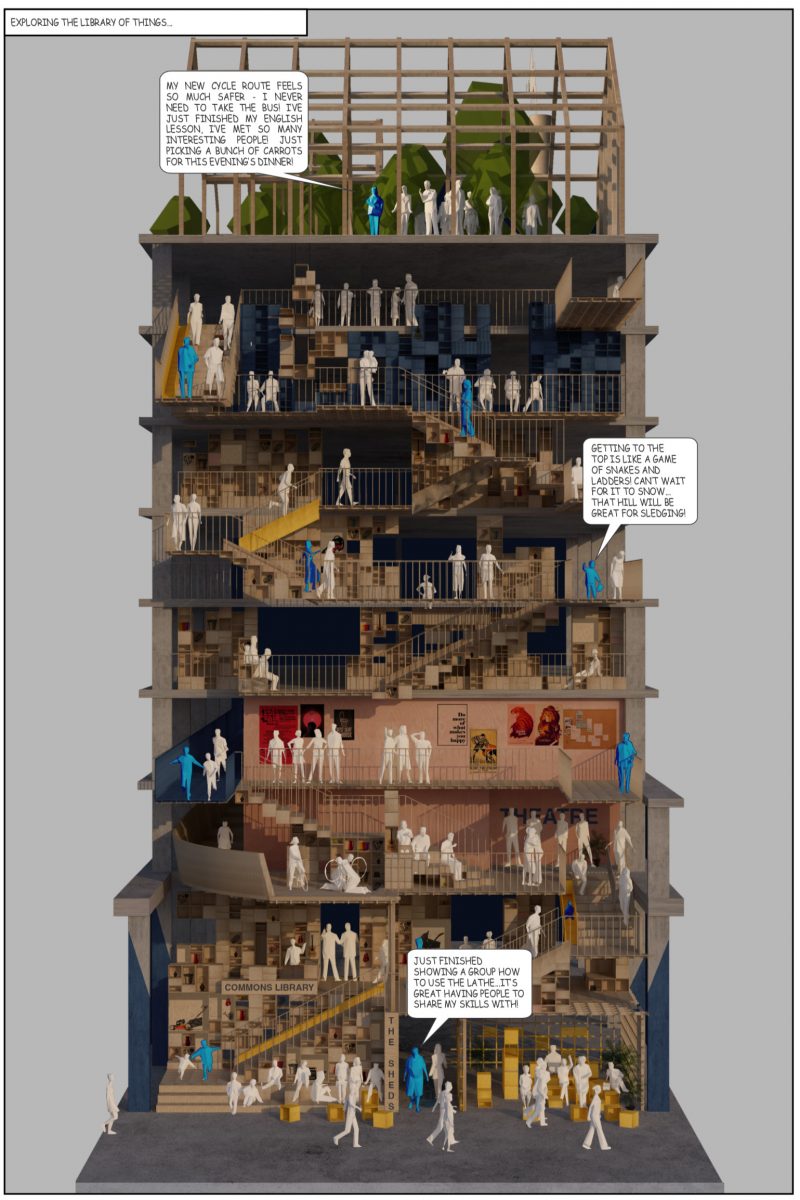
A day in the life of the commons, featuring the three demographics
The building is crowned by a series of pitched roof forms, in which the foundations of our new way of living in the city are established. Above the forest sits the caretakers’ lodge. This space would house an intergenerational living complex, where caretakers would live and look after the day-to-day running of the commons. Retirees and PhD students would live together, sharing their knowledge with users of the building and researching the building’s effect on health and wellbeing. Further along the roofscape, a series of greenhouses lead down into a kitchen and dining space. These spaces seek to establish a new relationship to community and food, creating healthier and more sustainable ways of eating.
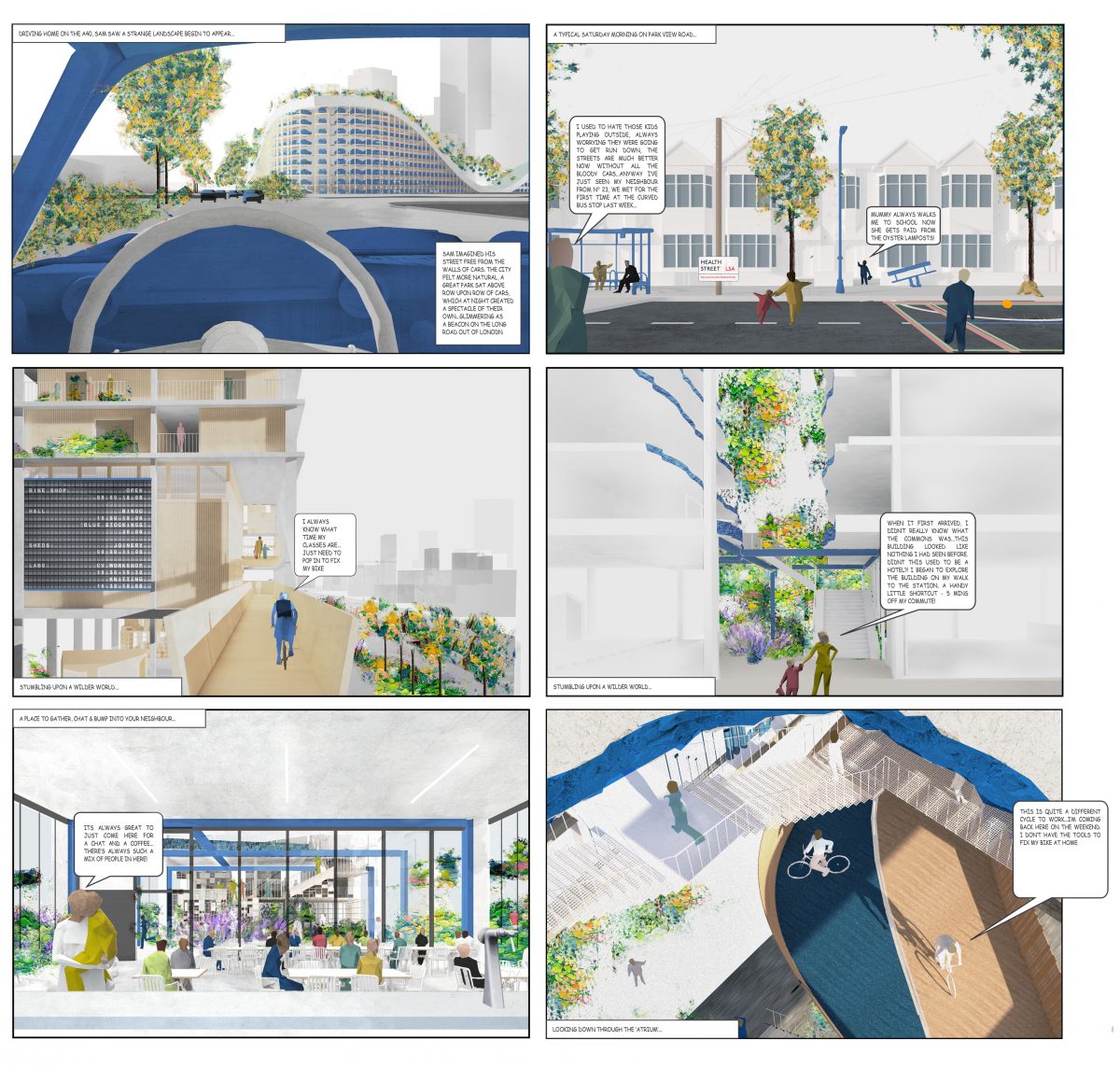
A day in the life of a healthier North Acton
Metabolic City is led by Christophe Egret and Mark Warren from Studio Egret West and Tomas Klassnik from Klassnik Corporation. Students: Tom Badger, William Bellamy, Alessandro Carlucci, Sam Nicholls, Katie Oliver, Eloise Rogers, Joe Walker.