

Knowledge
Professor Sadie Morgan OBE: ‘Let’s bring a bit of joy back in our lives’
LSA alumnus wins at Built Environment Awards 2026
Job opportunity: Caretaker
Dezeen School Show: LSA MArch
LSA Part 0 leads shortlisted at the NLA Awards
The LSA Award 2026 Winner: Caspar Barker
LSA Student Highly Commended at Architects for Health Student Design Awards
LSA student named a finalist for the Test of Time Awards
Architectural Education as a Situated Practice and the Little Free Library
From Crisis to Opportunity: Reframing the Future for Architecture Graduates
Architectural Education as a Situated Practice | London Festival of Architecture
LSA Student shortlisted for the AJ New Talent Award
If Only We Will: Degree Show 2026
Belonging by Design: A Collective Act | London Festival of Architecture
Design Think Tank: Call for Practice Briefs
LSA International Field Trip 2026: Belgium
LSA Representation in the AJ Small Projects 2026 shortlist
LSA Student Placement with Ryder Architecture
Alumni Case Study: Elliott Wang
Open Evening 1 April 2026
Design For Life returns this February
Call for Abstracts: Learnings/Unlearnings Conference
Part 0 Lead wins at Inspire Future Generations Awards
Applications open for MArch in Designing Architecture
The University of the Built Environment appoints new Professors
Get to know Lee Ivett
Open Evening 20 January 2026
LSA faculty nominated for Inspire Future Generations Awards
Yang Yang Chen shortlisted for Young Talent award
LSA Part 0 co-leads shortlisted for Inspire Future Generations Awards
LSA tutor is RIBA House of the Year finalist
Lee Ivett Open Evening Speech
Hugh Strange Architects: House of the Year 2025 shortlist
Lee Ivett starts as Head of School
LSA tutor wins Young Architect of the Year 2025
Open Evening 19 November 2025
AJ Student Prize | Postgraduate Winner: Amy Wilkinson
Hugh Strange Architects Shortlisted for RIBA Stirling Prize 2025
‘Design for Life’ returns this November – Part 4
Lee Ivett appointed as Head of School at London School of Architecture
George Moldovan shortlisted for 2025 Structural Timber Awards
‘A Seat at the Table’ Summer Show 2025
University of the Built Environment
OPEN DAY 11 June 2025
Future Skills Think Tank
LSA and UCEM merge
Future Skills Think Tank
Festival of the Future
Sixty years on from the London County Council: legacy, impact, learning
Dr Neal Shasore stepping down as Head of School and Chief Executive of the London School of Architecture (LSA) in February 2025
Load moreDesign Think Tanks – Emerging Tools
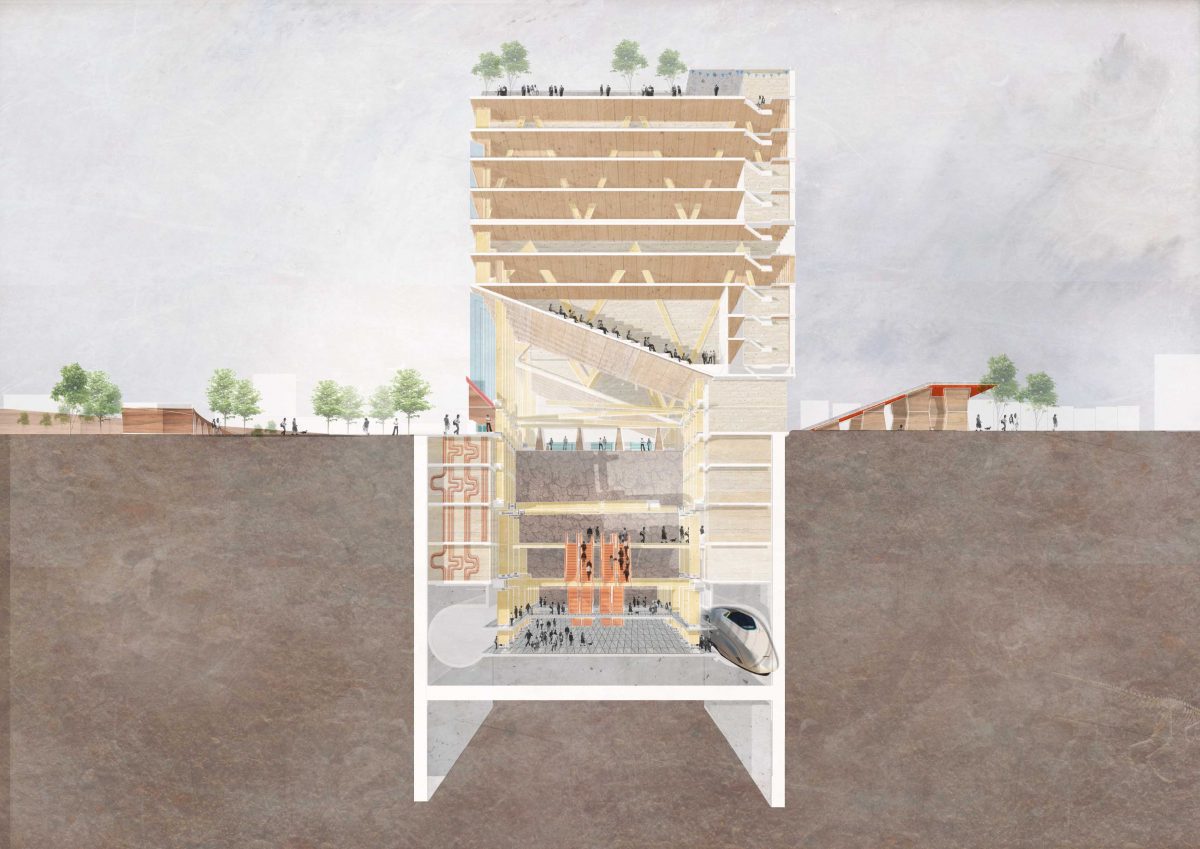
Short section
Emerging Tools proposes a Civic Station, a new model of transport infrastructure development that prioritises social wellbeing. Using Seven Sisters as a testbed, the project demonstrates how an alternative procurement route for Crossrail 2 can achieve a more equitable approach, creating skills, jobs and new housing.
Our proposal critically addresses the lessons learnt from the delivery of Crossrail 1. The aspiration is to ensure London and the UK’s future infrastructure adheres to the aims of the UN Sustainable Development Goals 9 and 11: making cities inclusive, safe and resilient for the future.
With Transit Oriented Developments usually encouraging professional and economic growth in the suburbs and the city, Seven Sisters lends itself to being an ideal testbed. The area, mostly residential in character, demonstrates clear needs and presents vast land availability for development.
To understand the implications of our research and proposal, the following agendas were identified, which need to be addressed to achieve a truly sustainable Transit Oriented Development.
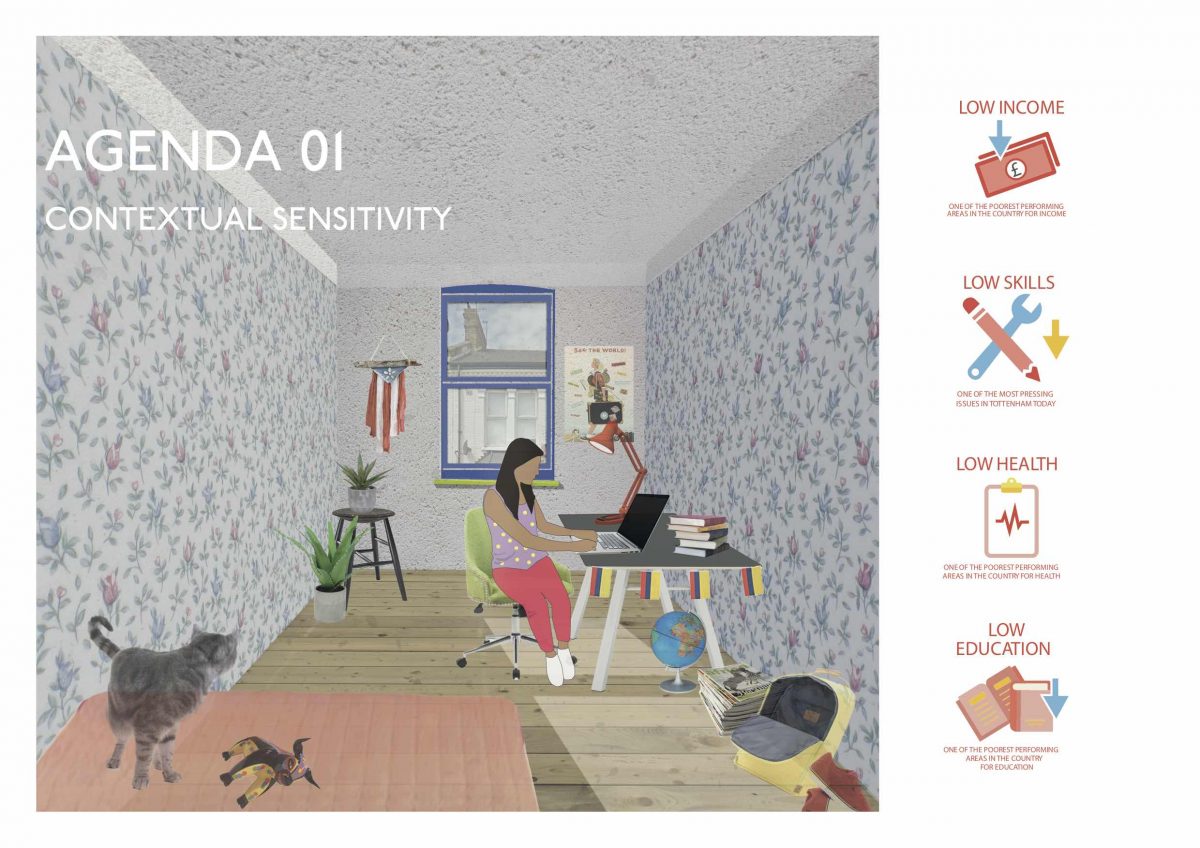
Agenda 1.
Seven Sisters is in one of the top 10 most deprived boroughs in the UK. In fact, with unemployment rates and skill shortages being the two most pressing issues in Tottenham today, one quarter of all adults living there have no qualifications at all, despite the relatively young population of the borough. Agenda 1 addresses the local conditions and promotes the benefits of the proposed development to the surrounding area.
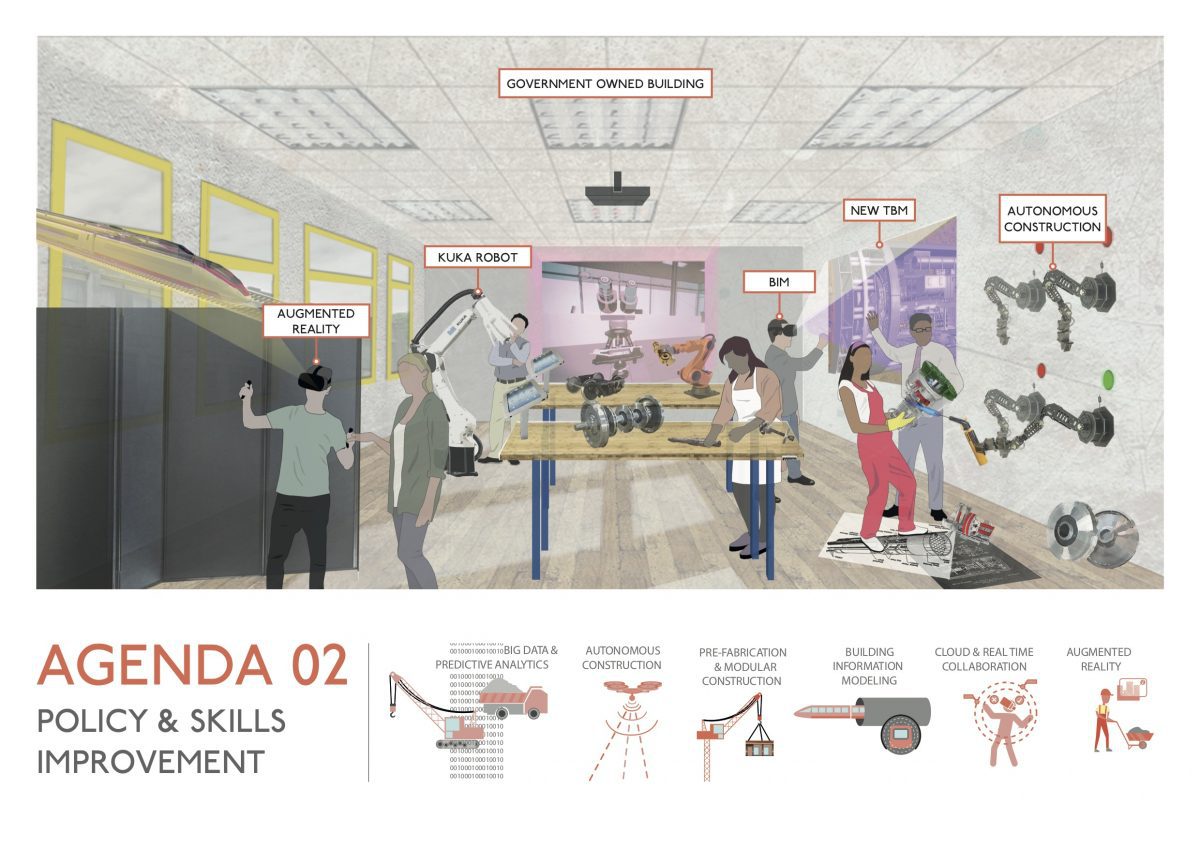
Agenda 2.
Agenda 2 represents our actions in response to the socio-economic divide of Haringey. By first implementing a new act of parliament, the Skills Act, contracted private infrastructure stakeholders are required to provide micro colleges to train the local workforce.
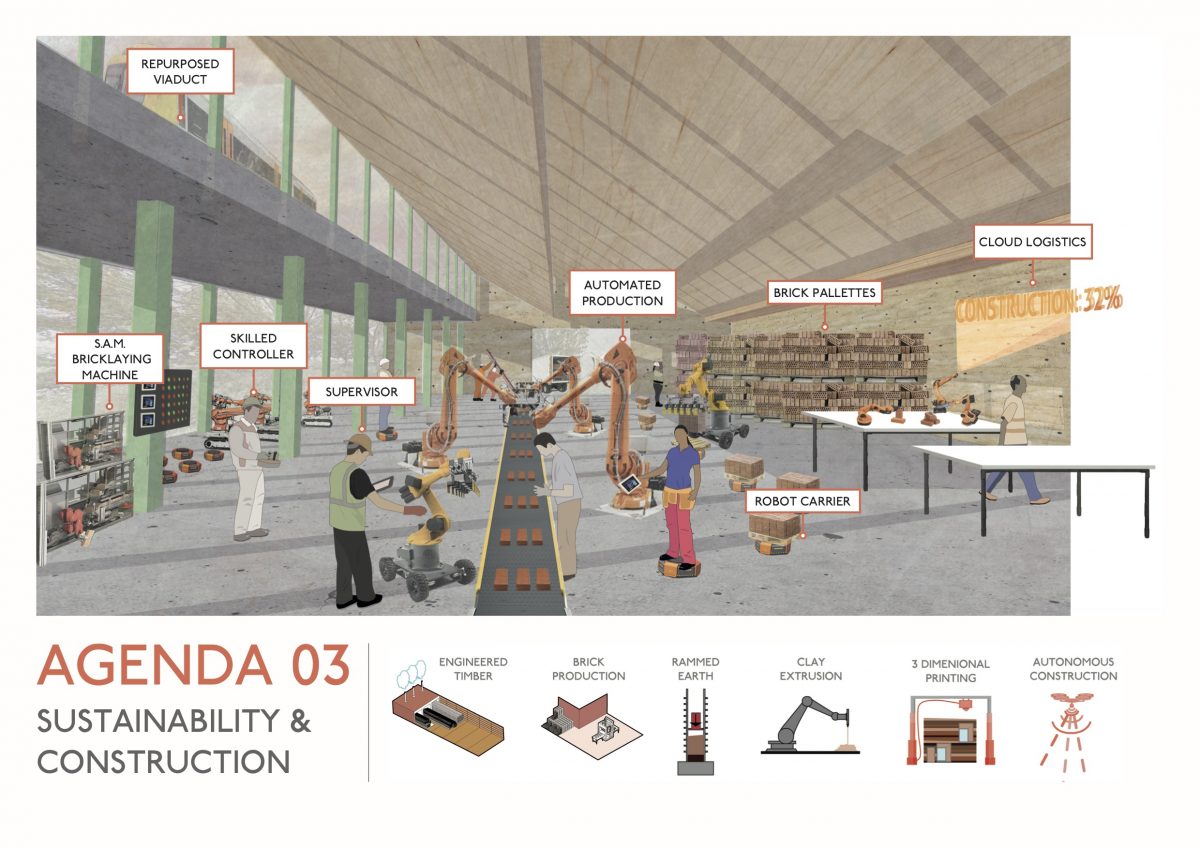
Agenda 3.
Agenda 3 touches on the methods we use to ensure that the time and environmental impact throughout construction is minimised. We found that the way to achieve this is through deploying a mix of on-site production and materials from the site, as well as prefabricated components. Informed by the fact that 7 million tonnes of earth were excavated for Crossrail 1, our proposal utilises earth more sustainably by incorporating it in the design, in the form of clay bricks, rammed-earth walls and 3D-printed clay products.
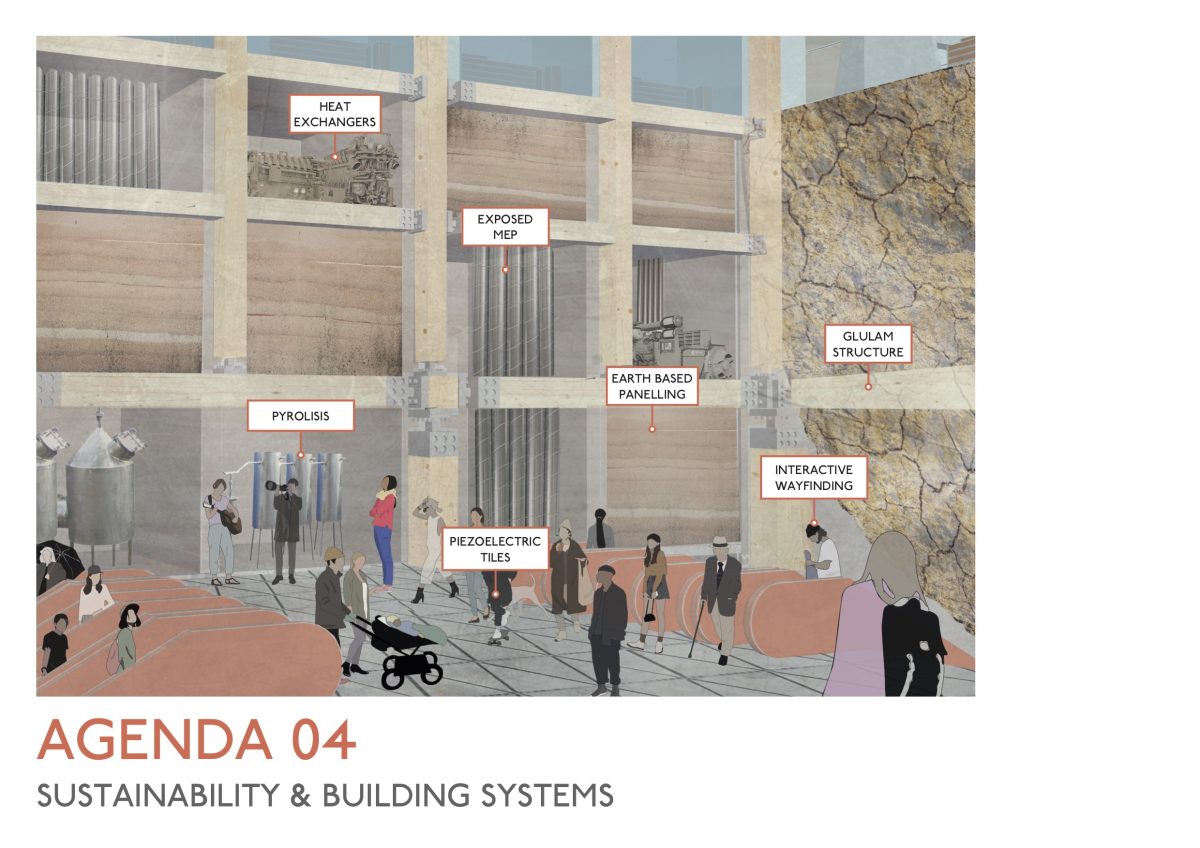
Agenda 4.
Agenda 4 demonstrates the various building systems that are both an integral aesthetic choice in our design, populating the flank walls of the station, but will also contribute to the efficient and sustainable role of the station’s environmental benefits.
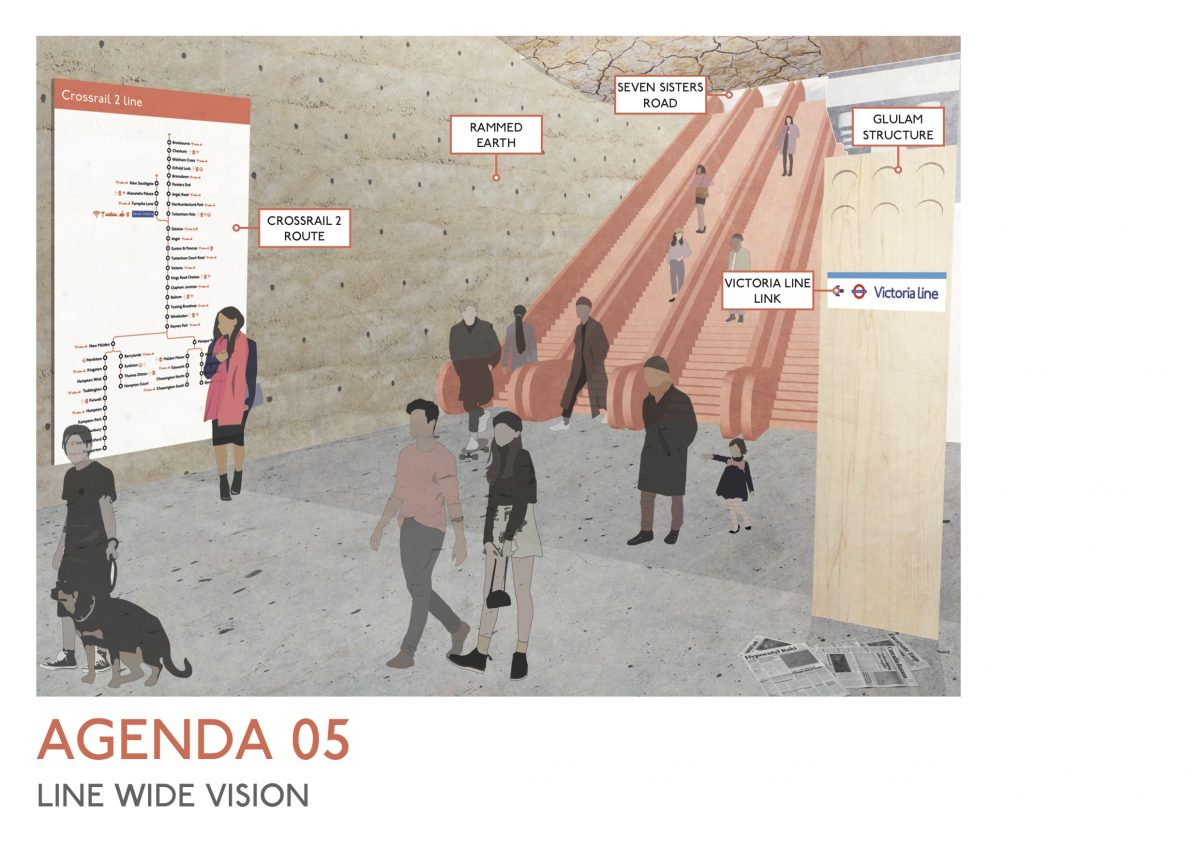
Agenda 5.
Building on such decentralisation, a line-wide vision of a sustainable grid arises, captured by Agenda 5. Moreover, through designing for local needs, different stations along the line will cater for various contextually driven purposes. This will further propagate our vision of enhanced connectivity, allowing for a sustainable urban life.
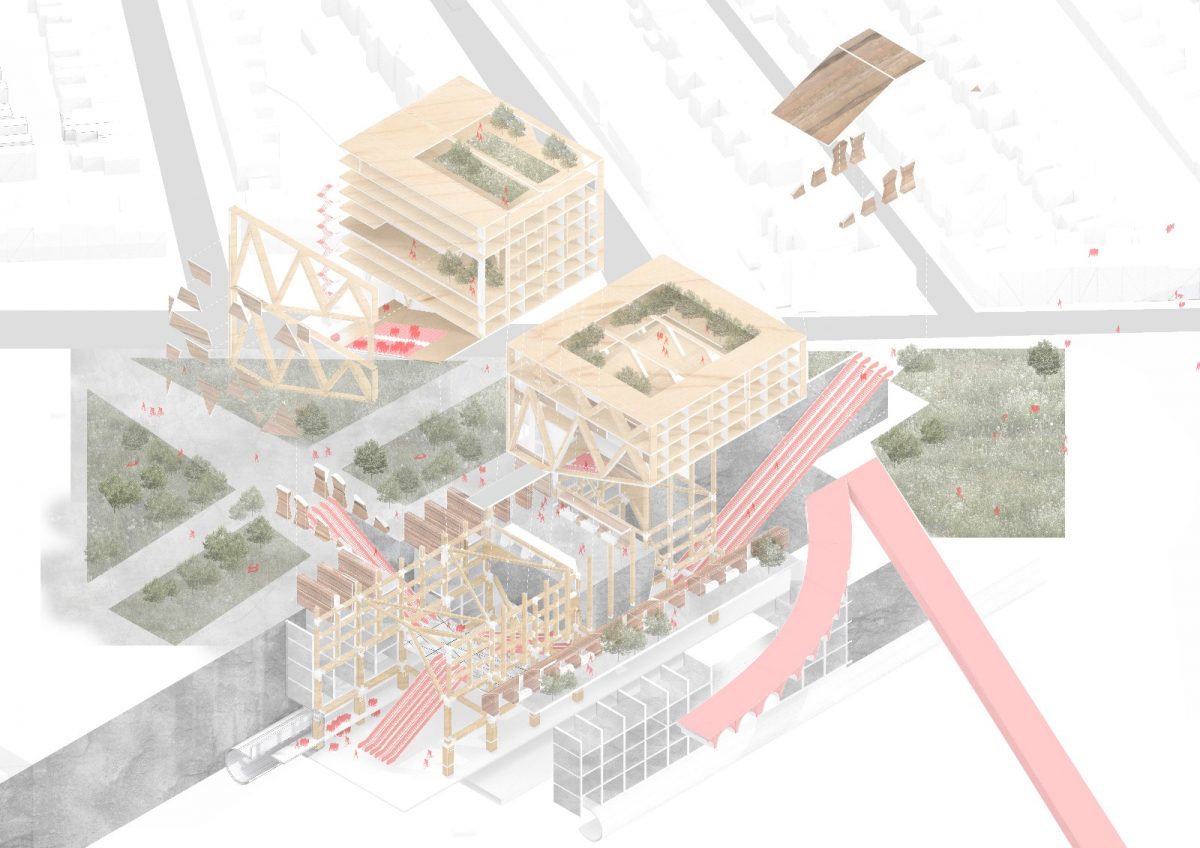
Material and structural articulation of final proposal.
Our final Agenda is to deliver a fully integrated Civic Station that contributes to the betterment of its locality, not only through an increase in connectivity and corresponding land value, but also enhancing social infrastructure. This is achieved through the incorporation of civic functions, such as the Latin Market and other retail opportunities into the perimeter of the station as well as the newly permeable Overground viaducts.
At a masterplan scale, the proposal aims to use the inaccessible land as an opportunity for additional housing and better connecting the surrounding neighbourhoods to what will be a new Civic Station and District Centre. Crossrail 2 will be a catalyst for development in Seven Sisters over a long period of time.
Key design moves are driven by the idea of ‘decentralised fabrication’: how should we retain industrial spaces in London? Our proposal explores new typologies where various uses, housing, industry and infrastructure can co-exist.
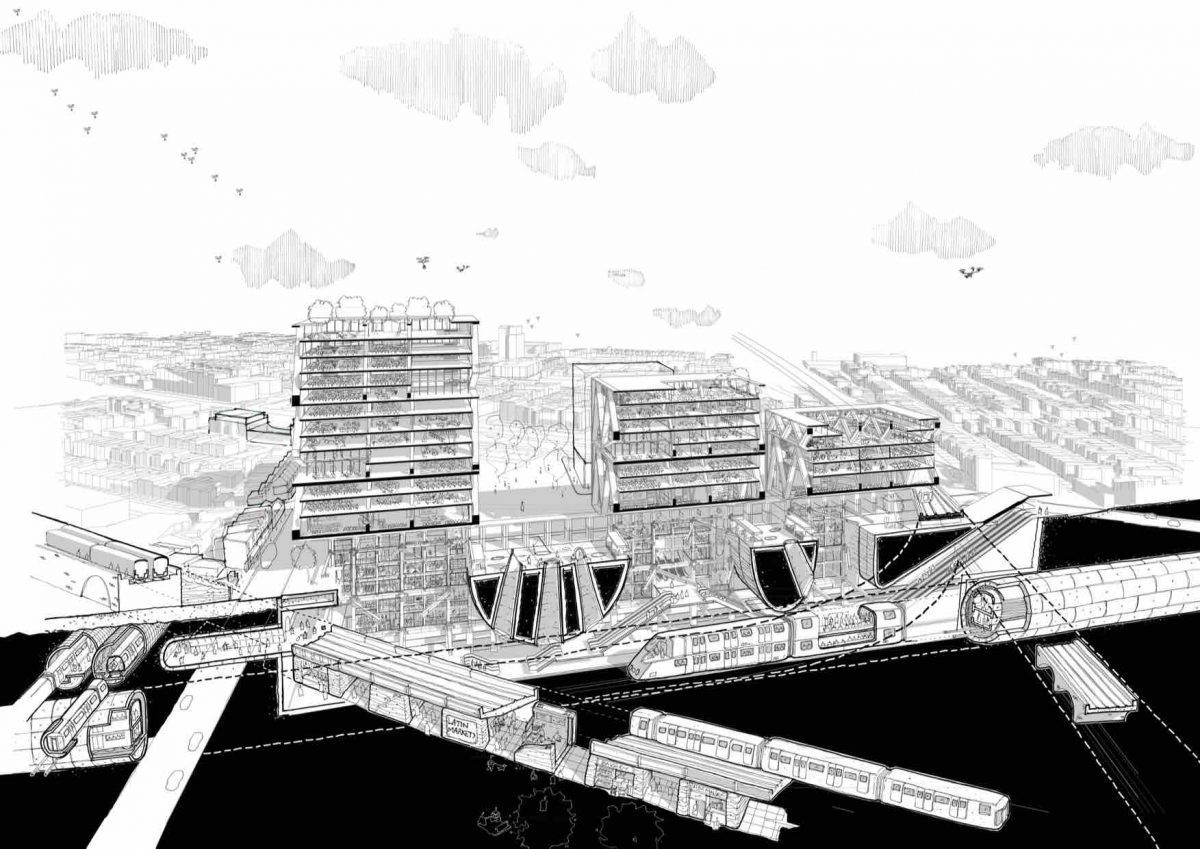
Sectional perspective of the proposal detailing relationships between the Oversite Development, the Civic Station and Social Infrastructure enhanced in the perimeter.
The station is made up of two main design elements: the station box and the oversite development which are divided into three building masses that step up towards the north-eastern side of the site, allowing for a maximum amount of natural light. To further assist that, light wells penetrate the rammed-earth ceiling in the main escalator entrance area, forming viewing platforms in the proposed public realm areas created between the massing above. Moreover, a series of flank wall shopfronts house Latin Market stalls, as well as other retail and civic functions, also located in the permeable viaduct and wider masterplan. Micro colleges and services populate the internal flank walls, with the former also occupying space in the over-station developments.
Lastly, the station forms an interchange connecting the Seven Sisters Overground and Underground stations with South Tottenham station, allowing easy access from the Victoria line straight to Crossrail 2 through a subway connection. Learning from our own experiences, our new Civic Station subverts what it means to be underground and celebrates transport infrastructure as a tool for an equitable society – a London built for all its citizens.
Emerging Tools is led by Harbinder Birdi, Krists Ernstsons and Benjamin Graham from Hawkins\Brown, Tessa Baird from OEB Architects and Rae Whittow-Williams from PDP London. Students: Matthew Barnett, Sara Lambridis, Fraser Morrison, Maxim Sas, Nic Shewan, Persa Tzemetzi.