

Knowledge
Professor Sadie Morgan OBE: ‘Let’s bring a bit of joy back in our lives’
LSA alumnus wins at Built Environment Awards 2026
Job opportunity: Caretaker
Dezeen School Show: LSA MArch
LSA Part 0 leads shortlisted at the NLA Awards
The LSA Award 2026 Winner: Caspar Barker
LSA Student Highly Commended at Architects for Health Student Design Awards
LSA student named a finalist for the Test of Time Awards
Architectural Education as a Situated Practice and the Little Free Library
From Crisis to Opportunity: Reframing the Future for Architecture Graduates
Architectural Education as a Situated Practice | London Festival of Architecture
LSA Student shortlisted for the AJ New Talent Award
If Only We Will: Degree Show 2026
Belonging by Design: A Collective Act | London Festival of Architecture
Design Think Tank: Call for Practice Briefs
LSA International Field Trip 2026: Belgium
LSA Representation in the AJ Small Projects 2026 shortlist
LSA Student Placement with Ryder Architecture
Alumni Case Study: Elliott Wang
Open Evening 1 April 2026
Design For Life returns this February
Call for Abstracts: Learnings/Unlearnings Conference
Part 0 Lead wins at Inspire Future Generations Awards
Applications open for MArch in Designing Architecture
The University of the Built Environment appoints new Professors
Get to know Lee Ivett
Open Evening 20 January 2026
LSA faculty nominated for Inspire Future Generations Awards
Yang Yang Chen shortlisted for Young Talent award
LSA Part 0 co-leads shortlisted for Inspire Future Generations Awards
LSA tutor is RIBA House of the Year finalist
Lee Ivett Open Evening Speech
Hugh Strange Architects: House of the Year 2025 shortlist
Lee Ivett starts as Head of School
LSA tutor wins Young Architect of the Year 2025
Open Evening 19 November 2025
AJ Student Prize | Postgraduate Winner: Amy Wilkinson
Hugh Strange Architects Shortlisted for RIBA Stirling Prize 2025
‘Design for Life’ returns this November – Part 4
Lee Ivett appointed as Head of School at London School of Architecture
George Moldovan shortlisted for 2025 Structural Timber Awards
‘A Seat at the Table’ Summer Show 2025
University of the Built Environment
OPEN DAY 11 June 2025
Future Skills Think Tank
LSA and UCEM merge
Future Skills Think Tank
Festival of the Future
Sixty years on from the London County Council: legacy, impact, learning
Dr Neal Shasore stepping down as Head of School and Chief Executive of the London School of Architecture (LSA) in February 2025
Load moreDaniel Booth — A Chance Encounter

The existing structure allows for varying functions; a school, studio and offices, residential space etc. A consistent bench at ground level encourages people to socialise without the need for a cafe.
A Chance Encounter — Residential living with social interaction at the forefront of every scale. By Daniel Booth
Location
Stratford Shopping Centre, London Borough of Newham
Objective
To transform a redundant shopping destination, The Stratford Centre, into a busy residential community in Newham with a focus on neighbourly relationships and dependencies.
Motivation
Time and time again structures are demolished to create private residential developments that eventually generate feelings of isolation for the inhabitants. Reduced shared space and limited neighbourly interactions can easily alienate city dwellers.
Strategy
The structural elements of the redundant shopping centre are retained and the spaces are reused for residential purposes. Densification is achieved by adding massing on top of the existing structure to create a central plaza and four further gardens. By overlapping key spaces and shifting the balance between private and shared space, neighbourly interaction is the focus at every scale.
Impact
To reduce the environmental impact of increasing population density by repurposing redundant structures as well nurturing social interaction to positively influence mental wellbeing in the city. To create a versatile structure that allows flexibility and generational changes.

The colonnade encourages dwelling and for shops/cafe/restaurants to spill out and adopt the space as their own. Market stalls can be erected on the inscribed grid with subtle changes in floor texture giving different functions.

Whilst the existing structure starts to divide the site into quadrants, the relationships of the quadrants, to one another and their adjoining spaces becomes prevalent. By overlapping the functions of spaces, the chance of a neighbourly encounter is greatly increased.

Access into the residents quadrants is through varying underpasses, creating an understanding of where a visitor can and can’t visit. South facing steps encourage people to sit late into the evening, creating a vibrant atmosphere.

Benches opposite gardens encourage public use and interaction whilst also acting as a shoe store to encourage residents to put their shoes on outside, furthering a chance encounter. The curved glazing at the entrance to each home acts as a moment for personality, allowing visitors to recognise houses.

The winter gardens are able to open up to the street, encouraging neighbours to engage with one another but also for the garden to spill out and start decorating the street, in the typical way that a front garden contributes to a streets aesthetic.
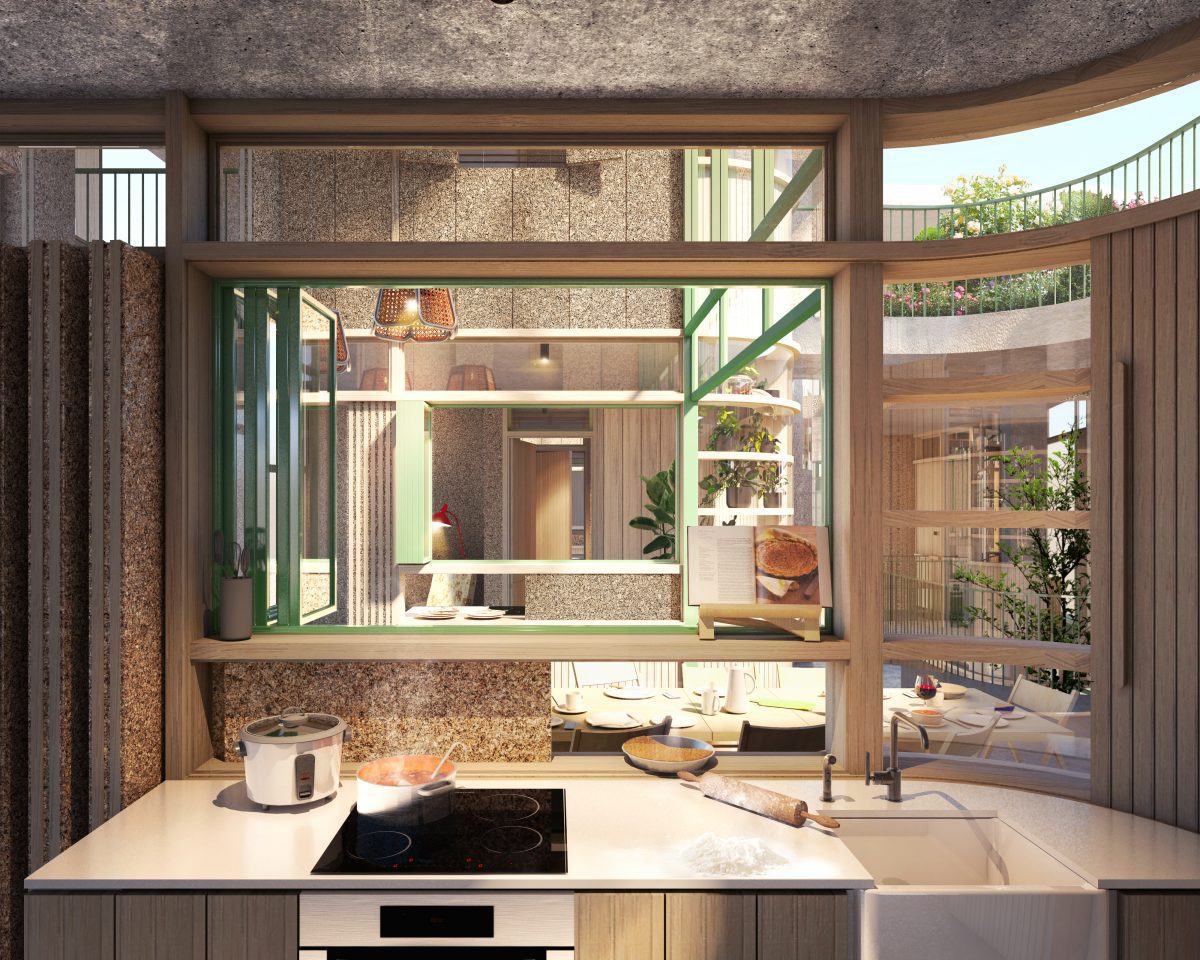
Triple aspect views and adjoining flexible walls allow the houses to engage on all sides. Views onto the street from the kitchen allow a parent to watch their child play. The windows into the street have a privacy screen which further wraps and shelters the kitchen, allowing residents to find privacy.

The Existing office Tower has an external brick structure allowing for internal flexibility. The modules developed are made of a series of components that can be adapted to form varying sized units and fit within a multitude of existing conditions.
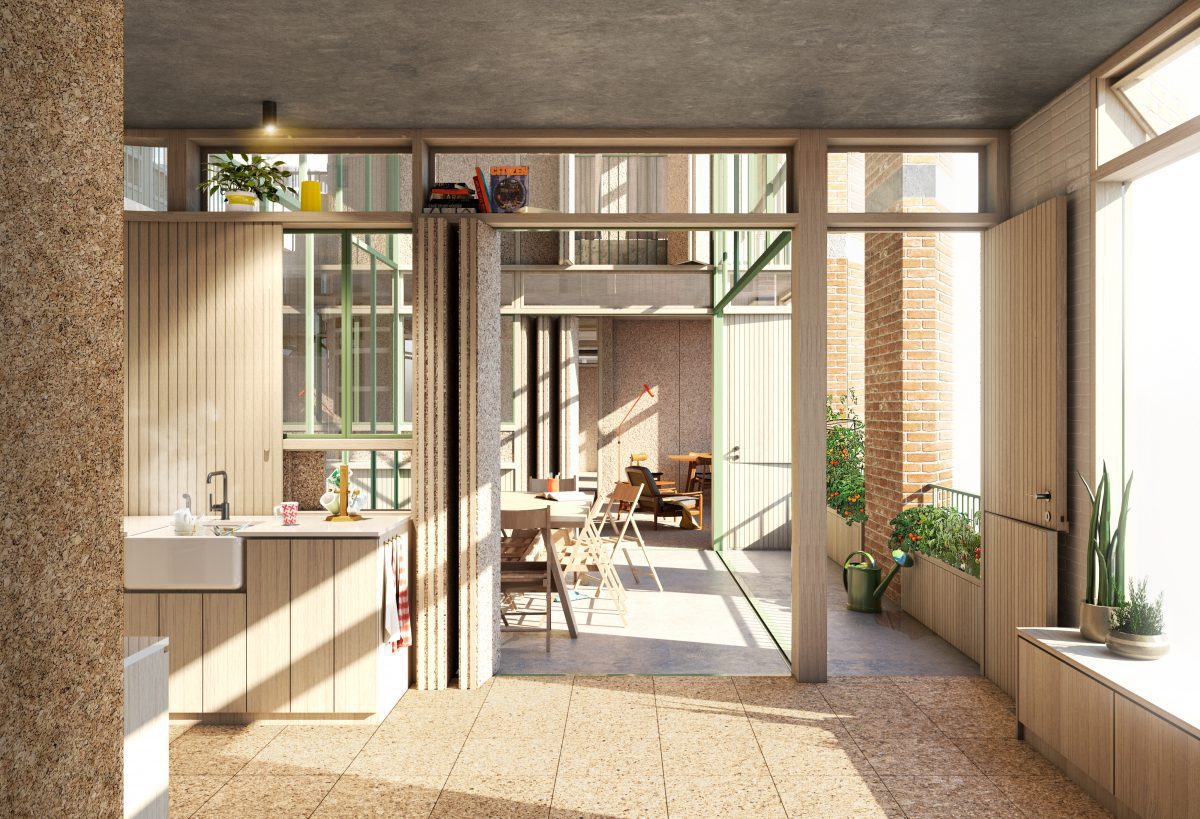
Inside a resident’s home, looking through to a shared garden beyond.
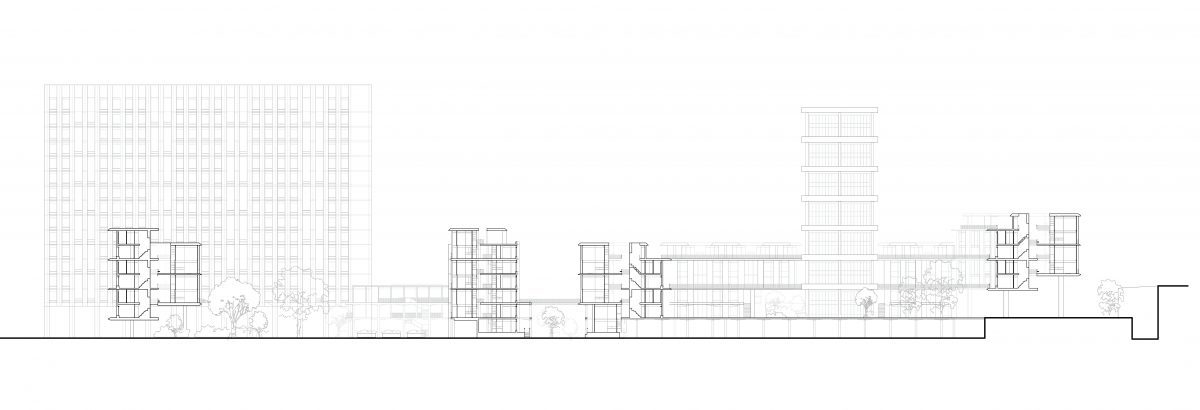
A long section through Stratford Heath ponds/Lido through to the growing garden. The street into the site shows the two courtyards adjoining the upper level, allowing residents free roam around the site and encouraging walks and exploration.
Further work
Contact details
- Daniel.booth94@gmail.com