

Knowledge
Professor Sadie Morgan OBE: ‘Let’s bring a bit of joy back in our lives’
LSA alumnus wins at Built Environment Awards 2026
Job opportunity: Caretaker
Dezeen School Show: LSA MArch
LSA Part 0 leads shortlisted at the NLA Awards
The LSA Award 2026 Winner: Caspar Barker
LSA Student Highly Commended at Architects for Health Student Design Awards
LSA student named a finalist for the Test of Time Awards
Architectural Education as a Situated Practice and the Little Free Library
From Crisis to Opportunity: Reframing the Future for Architecture Graduates
Architectural Education as a Situated Practice | London Festival of Architecture
LSA Student shortlisted for the AJ New Talent Award
If Only We Will: Degree Show 2026
Belonging by Design: A Collective Act | London Festival of Architecture
Design Think Tank: Call for Practice Briefs
LSA International Field Trip 2026: Belgium
LSA Representation in the AJ Small Projects 2026 shortlist
LSA Student Placement with Ryder Architecture
Alumni Case Study: Elliott Wang
Open Evening 1 April 2026
Design For Life returns this February
Call for Abstracts: Learnings/Unlearnings Conference
Part 0 Lead wins at Inspire Future Generations Awards
Applications open for MArch in Designing Architecture
The University of the Built Environment appoints new Professors
Get to know Lee Ivett
Open Evening 20 January 2026
LSA faculty nominated for Inspire Future Generations Awards
Yang Yang Chen shortlisted for Young Talent award
LSA Part 0 co-leads shortlisted for Inspire Future Generations Awards
LSA tutor is RIBA House of the Year finalist
Lee Ivett Open Evening Speech
Hugh Strange Architects: House of the Year 2025 shortlist
Lee Ivett starts as Head of School
LSA tutor wins Young Architect of the Year 2025
Open Evening 19 November 2025
AJ Student Prize | Postgraduate Winner: Amy Wilkinson
Hugh Strange Architects Shortlisted for RIBA Stirling Prize 2025
‘Design for Life’ returns this November – Part 4
Lee Ivett appointed as Head of School at London School of Architecture
George Moldovan shortlisted for 2025 Structural Timber Awards
‘A Seat at the Table’ Summer Show 2025
University of the Built Environment
OPEN DAY 11 June 2025
Future Skills Think Tank
LSA and UCEM merge
Future Skills Think Tank
Festival of the Future
Sixty years on from the London County Council: legacy, impact, learning
Dr Neal Shasore stepping down as Head of School and Chief Executive of the London School of Architecture (LSA) in February 2025
Load moreDesign Think Tanks – Global Currents

Facade elevation
The average house in London is only affordable for the top seven per cent of the population. The 100 per cent mortgages of the early 2000s were bailed out with the money for the next generation, those only now coming of age.
New rules reining in those excesses prevent this generation from getting a mortgage of their own. In the search for enough space to start a family, young people have two choices: to continue the unstable and transitory living of their early 20s, or leave the city. They can continue to rent, thereby transferring wealth upwards or abroad; or they can move out as far as it takes to get a mortgage.
Over the course of this term, we have attempted to understand what high density should look like when creating housing and ownership for young families in London. The nature of this challenge means we have had to address ideas of adaptability and culture, two aspects we see as key to success in dense situations. Young families are seen as a vital constituent to facilitate social cohesion and community, so they are the barometer from which successful housing must be measured. To get a taste of the variety of approaches to this type of freedom, we surveyed over 100 people about the favourite part of their houses to get a flavour of what they might build.
Ownership is really the overarching theme of the project – how the house becomes a home. We contend that ownership is the key to good housing, promoting longevity in the community rather than the pass-through housing of today.

An exploded isometric showing how different facade and core kit pieces can be selected to form the bare necessities of the apartment before the owner moves in.
Our solution? We propose a new way of funding affordable housing for young families; a way to cement their lives – family, social and professional – into the city fabric. Land values are the root of the London housing problem, yet councils are selling land to developers wholesale in the hope of paltry so-called ‘affordable’ housing hand-outs.
Our non-profit developer is called Homely, an enterprise aimed at promoting ownership for young families in London. Its method is to build adaptable units on council land recouped by Section 106. To further increase their affordability, these flats are sold in two stages, the first when families first arrive, with a 15-year tenancy agreement, and the second when that agreement expires, allowing for much smaller mortgages spread over time.

Mock-ups of different unit arrangements and fit-outs based on survey response from young families in the UK
However, young families are not just moving out to the suburbs for affordable prices, there is something in the way of living that has been ingrained in the British psyche over the last century. We believe some of this should be retained in high-density proposals, to make them an aspiration rather than a resignation. We reject the pancake floor-plate blocks of today for a more sensitive and receptive typology. The loft, the subconscious of the house where memories are stored and identity is retained; the stairs, which divide functions in the house and act as an incidental space for the occupants; the front garden, a mediation space between public and private; and the bay window, a space for overlooking and keeping watch on the public space. These elements can be seen throughout the drawings, incorporating these accepted British icons in the modern high-rise.

A sketch of the ground floor plan a proposal for Rotherhithe and a section of the scheme
The unit itself is centred around a desire for adaptability, allowing inhabitants to take ownership of their space. At the most basic level, this comes from the L-shaped section. Both flats enter on a shared Level 0, but step either up or down to a level that is the full width of the bay. This allows much of that second storey to be left open so that, to begin with, each flat has a large double-height space.
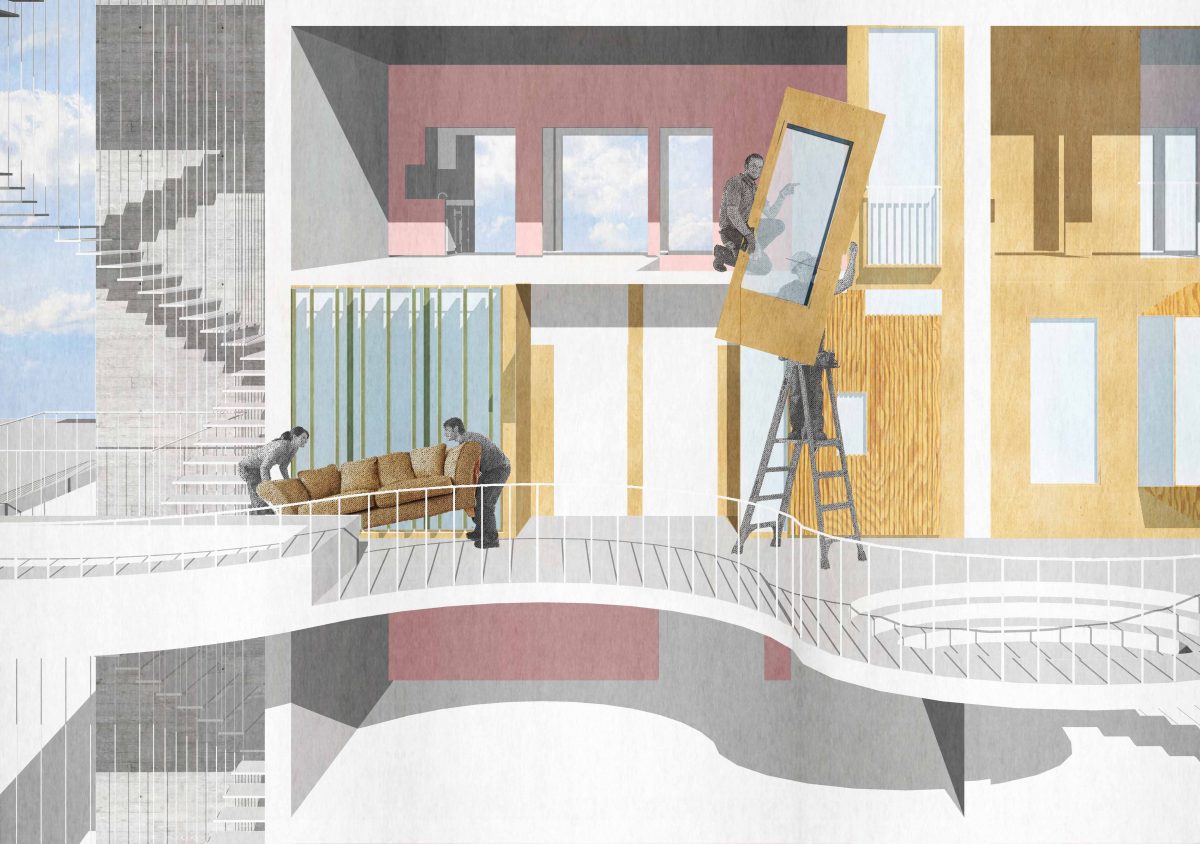
A view of one of the units as tradespeople assemble the basic fitout to prepare it for moving in. Here they are fitting the facade kit panels and the basic services
The genuine adaptability comes from the materials: timber is easily workable by the majority of tradespeople or any DIY-enthusiast owner. Externally, cross-laminated timber has been used to create a kit of facade modules as an off-the-shelf choice for most residents, yet, being based on a standard grid, they are easily replaceable and modifiable down the line.

The same unit after residents have moved in, with plants starting to flourish in the architecture and the external spaces being used
The reality of this adaptable approach is that units can take on the shape of their users. With ownership over their space and long tenancy agreements, there is real value in investing in your home, adapting and changing it at will. Although this may sound aspirational, it is a pastime that is deeply rooted in the traditional British home. Walter Segal’s British self-build, the house extension and the loft conversion are real indicators of a taste for this kind of agency in housing.
Global Currents is led by Steven Kennedy from Grimshaw, Javier Quintana from IDOM, Joseph Zeal-Henry from Jestico + Whiles, Chris Worsfold from Wimshurst Pelleriti. Students: Robert Buss, James Clarke, Abiel Hagos, Cameron Lintott, Roni Zachor Barak.