

Knowledge
Professor Sadie Morgan OBE: ‘Let’s bring a bit of joy back in our lives’
LSA alumnus wins at Built Environment Awards 2026
Job opportunity: Caretaker
Dezeen School Show: LSA MArch
LSA Part 0 leads shortlisted at the NLA Awards
The LSA Award 2026 Winner: Caspar Barker
LSA Student Highly Commended at Architects for Health Student Design Awards
LSA student named a finalist for the Test of Time Awards
Architectural Education as a Situated Practice and the Little Free Library
From Crisis to Opportunity: Reframing the Future for Architecture Graduates
Architectural Education as a Situated Practice | London Festival of Architecture
LSA Student shortlisted for the AJ New Talent Award
If Only We Will: Degree Show 2026
Belonging by Design: A Collective Act | London Festival of Architecture
Design Think Tank: Call for Practice Briefs
LSA International Field Trip 2026: Belgium
LSA Representation in the AJ Small Projects 2026 shortlist
LSA Student Placement with Ryder Architecture
Alumni Case Study: Elliott Wang
Open Evening 1 April 2026
Design For Life returns this February
Call for Abstracts: Learnings/Unlearnings Conference
Part 0 Lead wins at Inspire Future Generations Awards
Applications open for MArch in Designing Architecture
The University of the Built Environment appoints new Professors
Get to know Lee Ivett
Open Evening 20 January 2026
LSA faculty nominated for Inspire Future Generations Awards
Yang Yang Chen shortlisted for Young Talent award
LSA Part 0 co-leads shortlisted for Inspire Future Generations Awards
LSA tutor is RIBA House of the Year finalist
Lee Ivett Open Evening Speech
Hugh Strange Architects: House of the Year 2025 shortlist
Lee Ivett starts as Head of School
LSA tutor wins Young Architect of the Year 2025
Open Evening 19 November 2025
AJ Student Prize | Postgraduate Winner: Amy Wilkinson
Hugh Strange Architects Shortlisted for RIBA Stirling Prize 2025
‘Design for Life’ returns this November – Part 4
Lee Ivett appointed as Head of School at London School of Architecture
George Moldovan shortlisted for 2025 Structural Timber Awards
‘A Seat at the Table’ Summer Show 2025
University of the Built Environment
OPEN DAY 11 June 2025
Future Skills Think Tank
LSA and UCEM merge
Future Skills Think Tank
Festival of the Future
Sixty years on from the London County Council: legacy, impact, learning
Dr Neal Shasore stepping down as Head of School and Chief Executive of the London School of Architecture (LSA) in February 2025
Load moreLife after the LSA: Studio 8Fold
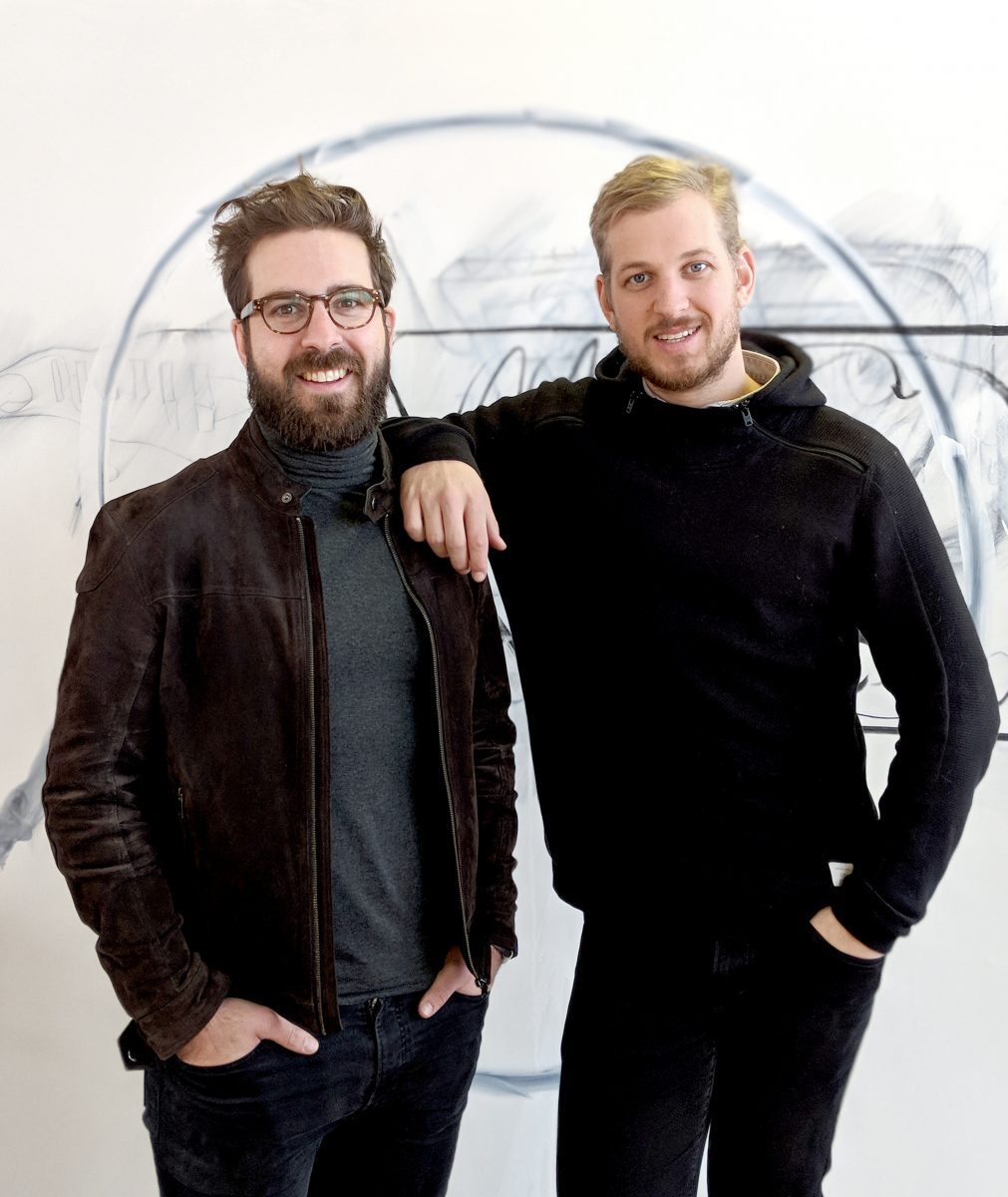
Aleks and Alex photographed at their studio at aLL Design, who is part of the LSA Practice Network
Studio 8Fold is the first new practice to emerge from the LSA. Established by Alexander Frehse and Aleksandar Stojakovic soon after they graduated in the summer of 2017, Vicky Richardson spoke to the pair about their first six months.
Where does the name of the practice come from?
Alex & Aleks: We were discussing what we wanted to do as a practice. We were interested in the idea of taking a brief, breaking it down and seeing it in a completely different way. There’s a myth that you can only fold a piece of paper in half seven times – until recently it was thought that physics simply doesn’t allow it. But we heard about a group in Japan which was the first to figure out that if you have a different shape of paper you can go beyond even eight folds. The name Studio 8Fold encapsulates our idea that if you reassess the framework within which you’re working, you can achieve things that no one thinks are possible: debunking myths is what we want to do in our practice.
How did you meet?
A&A: We met in Cape Town in 2010 at the registration office for undergraduates. We were both standing in the queue!
Aleks: After my degree I came to London and worked at PDP before starting at the LSA and Grimshaw.
Alex: I went down a different route and initially we parted ways. I first went to Santiago in Chile where I worked for Alejandro Aravena, which was a remarkable experience. Then I went back to South Africa and did a one year honours as a prelude to masters. But I soon got itchy feet again and wanted to go to Europe so I applied to PDP and ended up working with Aleks again.
A&A: There were 20 Part One students at PDP, all in the process of applying to typical schools. A debate about architectural education came up among us and a few students were interested in the LSA, but said they didn’t have the guts to apply.
Why did it take guts to apply – did you see it as a risk?
A&A: It was a calculated risk. We weren’t so worried about the lack of RIBA/ARB accreditation – we knew that with the calibre of staff and experience (people like Peter Buchanan and James Soane), it was only a matter of time before the LSA gained accreditation.
The risk was the model of education, which was completely new, although coming from South Africa – where you walk the earth and design for the people – it seemed more familiar. The LSA seemed to have a similar hands-on approach but with more rigorous theoretical teaching. We were also encouraged by the fact that we knew there would be like-minded people with us taking this leap.
So how did you find it?
A&A: We felt fully engaged with the LSA as a new project – you had to be engaged just to know where you were meant to be! Education is becoming a kind of service-based industry, but it definitely didn’t feel like that at the LSA. We were helping to make decisions about the future of the school. There were platforms where the whole class was engaged in discussion, and equally we were able to have informal conversations with teachers and staff.

A view of Wasteminster, Aleksandar Stojakovic’s thesis project for the LSA
Have ideas from the LSA carried through into practice?
A&A: The idea of agency is still really important to us, that as an architect you bring people together from different industries rather than working in a vacuum. Among other projects, we’re continuing to work on Aleks’s thesis project, Wasteminster, which dealt with the food crisis in London and proposed a new type of small-scale infrastructure, community based that provides education, living, research and energy in the form of biomass. For the thesis project it was sited at Brewer Street car park in Soho. At this stage we know there’s a lot still to be done to turn a thesis into a real world project, but we’re in early discussions with the GLA and feel optimistic.
What else are you working on?
A&A: Mostly residential projects, getting experience of building on a small scale. We also have an interesting project in Sri Lanka – a children’s library in a rural school – which aligns with our interest in socially-driven projects.
Our first completed project was the conversion of a maisonette in Notting Hill. Aleks and I started designing this during our final year and two days after we graduated we were on site! It’s a typical 1960s maisonette, where our Australian client who is a sculptor, gave us the freedom to expose the concrete slab of the structure and to create a new L-shaped staircase as the focal point.
What’s next for Studio 8Fold?
A&A: Our ambition is to be operating in the UK and across Africa. The idea is to join up with a colleague in South Africa and create a link between Europe and African cities where we see most of the future development of the world happening.
Before doing that we have a plan to drive home to Cape Town: we’ll travel through the north west via Nigeria, Senegal, Ghana, across to Ethiopia, Nairobi and Dar es Salaam. During the journey we’ll do research, meet people and from that create a springboard for a larger practice.