

Knowledge
Professor Sadie Morgan OBE: ‘Let’s bring a bit of joy back in our lives’
LSA alumnus wins at Built Environment Awards 2026
Job opportunity: Caretaker
Dezeen School Show: LSA MArch
LSA Part 0 leads shortlisted at the NLA Awards
The LSA Award 2026 Winner: Caspar Barker
LSA Student Highly Commended at Architects for Health Student Design Awards
LSA student named a finalist for the Test of Time Awards
Architectural Education as a Situated Practice and the Little Free Library
From Crisis to Opportunity: Reframing the Future for Architecture Graduates
Architectural Education as a Situated Practice | London Festival of Architecture
LSA Student shortlisted for the AJ New Talent Award
If Only We Will: Degree Show 2026
Belonging by Design: A Collective Act | London Festival of Architecture
Design Think Tank: Call for Practice Briefs
LSA International Field Trip 2026: Belgium
LSA Representation in the AJ Small Projects 2026 shortlist
LSA Student Placement with Ryder Architecture
Alumni Case Study: Elliott Wang
Open Evening 1 April 2026
Design For Life returns this February
Call for Abstracts: Learnings/Unlearnings Conference
Part 0 Lead wins at Inspire Future Generations Awards
Applications open for MArch in Designing Architecture
The University of the Built Environment appoints new Professors
Get to know Lee Ivett
Open Evening 20 January 2026
LSA faculty nominated for Inspire Future Generations Awards
Yang Yang Chen shortlisted for Young Talent award
LSA Part 0 co-leads shortlisted for Inspire Future Generations Awards
LSA tutor is RIBA House of the Year finalist
Lee Ivett Open Evening Speech
Hugh Strange Architects: House of the Year 2025 shortlist
Lee Ivett starts as Head of School
LSA tutor wins Young Architect of the Year 2025
Open Evening 19 November 2025
AJ Student Prize | Postgraduate Winner: Amy Wilkinson
Hugh Strange Architects Shortlisted for RIBA Stirling Prize 2025
‘Design for Life’ returns this November – Part 4
Lee Ivett appointed as Head of School at London School of Architecture
George Moldovan shortlisted for 2025 Structural Timber Awards
‘A Seat at the Table’ Summer Show 2025
University of the Built Environment
OPEN DAY 11 June 2025
Future Skills Think Tank
LSA and UCEM merge
Future Skills Think Tank
Festival of the Future
Sixty years on from the London County Council: legacy, impact, learning
Dr Neal Shasore stepping down as Head of School and Chief Executive of the London School of Architecture (LSA) in February 2025
Load moreLife After the LSA: PIVOT Studio

Jack Idle (left) and Ian Campbell (right).
Since graduating in 2017 as part of LSA’s first cohort, Ian Campbell and Jack Idle have gone on to start PIVOT Studio, an architectural design company, and PIVOT Cities, a student mentoring platform. Jason Sayer spoke to them both to see how life after the LSA was going and what was on the horizon.
What was your final year project?
Ian: I was interested in how new ways of working had made the discrete office building no longer a relevant unit in the city. My project Fieldwork envisioned five buildings around Soho Square to develop together into a highly interdependent working campus. By pooling spatial resources around public amenity, Soho could continue to foster an internationally competitive creative ecology in spite of spiralling land values.
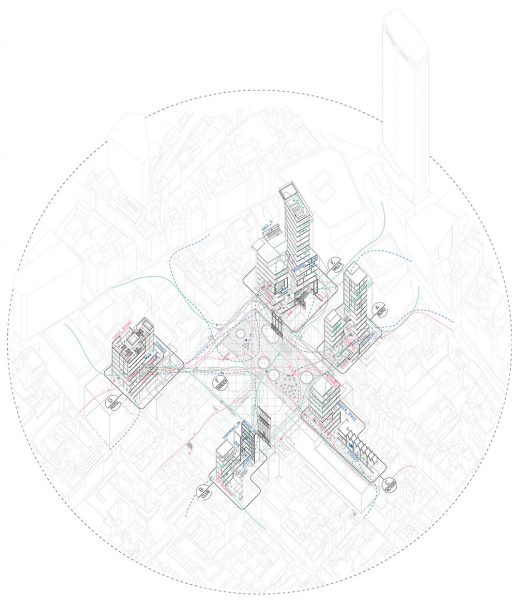
Fieldwork. (credit: Ian Campbell)
Jack: My project was called City Making Hall. It imagined a new institution for integrating the processes that build the city around us, breaking down the silos between planner, developer, architect and the public. With new modes of discussing the design and development of London, we could create more positive and fascinating pieces of city.
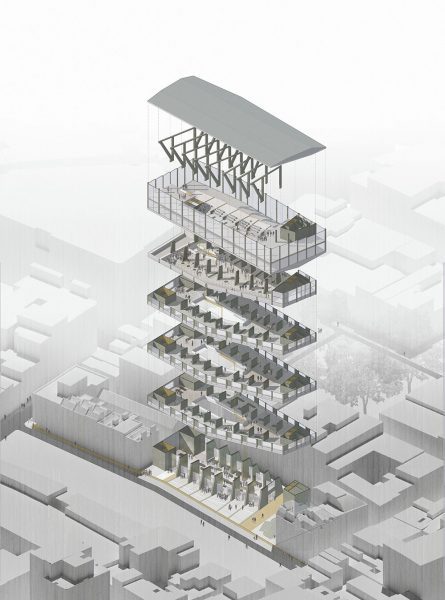
City Making Hall. (credit: Jack Idle)
What made you set up PIVOT Studio?
I&J: We are particularly interested in working on the strategy, feasibility and early design stages of residential projects, whether in collaboration with developers such as Supported Living Homes, or architect developers like CarsonSall.
J: We both really enjoyed James Soane’s and Peter Buchanan’s lectures which discussed the critical factors which shape a project – not just taking it at surface value but picking apart the brief, and often the architect’s role. These fuelled a hunger to build a practice that integrates our understanding of the built environment’s pivotal role in long-term sustainability into the start of projects.
I: We position ourselves at the intersection between property development and architecture. PIVOT Studio is part of a wider practice that engages creatively with both finance and design to deliver more elegant and sustainable solutions.
J: Exploring the financial intricacies of a project, as boring as that may sound to some, brings a fluency with which design decisions are viable and where value can be added. In addition to our interest in a project’s wider impact, we’re also keen to hone our skills with negotiating and adhering to design guidelines and regulations.
What is PIVOT Studio currently working on?
I: A project in Northampton for Supported Living Homes, which will develop an underused office building into 14 flats, all designed to be adaptable for people with learning difficulties or physical disabilities.
What is PIVOT Cities?
I&J: Since leaving the LSA we’ve both enjoyed a continuing involvement with the school, and have worked with some of the Second Year students and their projects. PIVOT Cities takes this support forwards as a mentoring platform for architecture students which offers a supplementary process for personal development outside the scrutiny of academic programmes. We enjoy helping to build the personal confidence and self-awareness necessary for a coherent and effective student proposition. Our wider ambition is to explore strategies for more sustainable cities through expanding architectural discourse into an intersection with the dynamics of real estate development and emerging energy infrastructures.
J: With PIVOT Cities, the forum for dialogue is slightly more open and informal which allows ideas to be sketched out and improved upon.
What else are you working on?
I&J: TURF, a positive development startup. We are fascinated by the opportunities in unlocking the business case for more sustainable urban architecture. TURF is starting out with the mission to champion positive development in cities as a sustainability solution, unlocking new value through enhancing and restoring the natural environment. Our strategy is driven by a desire to develop and operate extraordinary homes that offer residents a rich experience of sustainability which has a tangible positive impact.
J: With TURF, we want to take forward the client side of things. This, again, stems from our time at the LSA, through the critical practice module and thesis projects, discovering the dominant role of clients and their financing structures in the sustainable development of the built environment.
What else have you taken from your time at the LSA into practice?
I&J: An interest in anti-disciplinary practice, breaking down silos in order to maximise positive impact in the face of the complex issues and accelerating state of change in cities.
I&J: The humanity and planet lecture series by Peter Buchanan. This lecture series really inspired our guiding vision that cities enhance people’s connectedness with each other, with place and with the planet.
I&A: In the past year since graduating, we both worked for Clive Sall Architecture. Working for Clive, [who is Director of Proto-Practice at the LSA] we developed a professional skill set which grew out of the principles taught at the LSA. Clive has given us invaluable continued support and has always been helpful and accommodating with our new venture.
How do you work together?
I: We’re not joined at the hip, but our different approaches work really well together. I’d say Jack is better at pushing ideas forward quickly, whereas I am more in the detail side of the things addressing the specifics which creates an interesting dialogue.