

Knowledge
Professor Sadie Morgan OBE: ‘Let’s bring a bit of joy back in our lives’
LSA alumnus wins at Built Environment Awards 2026
Job opportunity: Caretaker
Dezeen School Show: LSA MArch
LSA Part 0 leads shortlisted at the NLA Awards
The LSA Award 2026 Winner: Caspar Barker
LSA Student Highly Commended at Architects for Health Student Design Awards
LSA student named a finalist for the Test of Time Awards
Architectural Education as a Situated Practice and the Little Free Library
From Crisis to Opportunity: Reframing the Future for Architecture Graduates
Architectural Education as a Situated Practice | London Festival of Architecture
LSA Student shortlisted for the AJ New Talent Award
If Only We Will: Degree Show 2026
Belonging by Design: A Collective Act | London Festival of Architecture
Design Think Tank: Call for Practice Briefs
LSA International Field Trip 2026: Belgium
LSA Representation in the AJ Small Projects 2026 shortlist
LSA Student Placement with Ryder Architecture
Alumni Case Study: Elliott Wang
Open Evening 1 April 2026
Design For Life returns this February
Call for Abstracts: Learnings/Unlearnings Conference
Part 0 Lead wins at Inspire Future Generations Awards
Applications open for MArch in Designing Architecture
The University of the Built Environment appoints new Professors
Get to know Lee Ivett
Open Evening 20 January 2026
LSA faculty nominated for Inspire Future Generations Awards
Yang Yang Chen shortlisted for Young Talent award
LSA Part 0 co-leads shortlisted for Inspire Future Generations Awards
LSA tutor is RIBA House of the Year finalist
Lee Ivett Open Evening Speech
Hugh Strange Architects: House of the Year 2025 shortlist
Lee Ivett starts as Head of School
LSA tutor wins Young Architect of the Year 2025
Open Evening 19 November 2025
AJ Student Prize | Postgraduate Winner: Amy Wilkinson
Hugh Strange Architects Shortlisted for RIBA Stirling Prize 2025
‘Design for Life’ returns this November – Part 4
Lee Ivett appointed as Head of School at London School of Architecture
George Moldovan shortlisted for 2025 Structural Timber Awards
‘A Seat at the Table’ Summer Show 2025
University of the Built Environment
OPEN DAY 11 June 2025
Future Skills Think Tank
LSA and UCEM merge
Future Skills Think Tank
Festival of the Future
Sixty years on from the London County Council: legacy, impact, learning
Dr Neal Shasore stepping down as Head of School and Chief Executive of the London School of Architecture (LSA) in February 2025
Load moreElliot Bennett reflects on his first year at the LSA
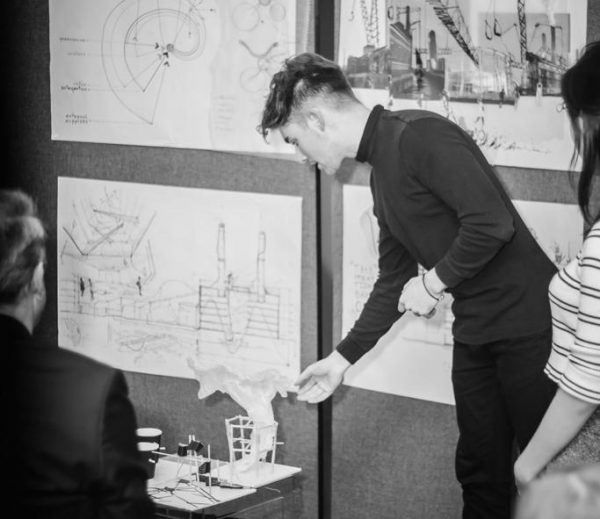
The most important people at any school are its students and at LSA that’s no exception. But what’s it actually like to study here? We spoke to First Years, Second Years and alumni so you can find out first hand. Elliot Bennett is a First Year at the LSA. He is currently doing his practice placement at Populous and has also started multidisciplinary design group with fellow students to explore the relationship between architecture, art, graphics and fashion.
What attracted you to the school in the first place?
The LSA provided an attractive alternative to traditional architectural education. I enjoyed my time in practice post Part 1 and the prospect of continuing my studies whilst working was a rare opportunity that I did not want to overlook. The school asks students to apply design, research and theory to the city of London whilst situating itself and the students at the centre. Capitalising on the practice network was also a key driver for my application as the school locates its classes throughout the city of London allowing glimpses of various architectural practices and event spaces.
What are Design Think Tanks like? What’s it like working in a group in this scenario?
The Design Think Tanks are a three-month period of focused design development into a research theory initiated by the LSA tutors and Design Think Tank leaders but followed through by you, the students. These are a great way to explore a shared interest with a small group of the cohort. You are encouraged to investigate the think tank thoroughly through theory, initial spatial proposals, and finally applying your development to an area / test bed of the city.
A culture of working and socialising together often develops between each DTT group due to the amount of time and proximity together. It is important to make time for socialising as a group between the research and design development in order to build understanding beyond the architecture course. Collaborative design is at the heart of architectural practice and the think tanks help students to develop working like as well as being able to understand and harness individual strengths.

Elliot working with his Design Think Tank, Playful City, this year.

Elliot’s DTT, Playful City, explored how play can be the antidote to city life.
What do you hope Second Year will be like?
Whilst first year provided a platform to identify and question my position within the profession, I am looking forward to focusing my time towards an individual agenda following the research processes that we have applied during the design think tanks. The second year should also be a time to build on the studio culture within the cohort through opportunities outside of the course, like informal talks, pub socials or sport.
What do you want your architecture to achieve and has this ambition changed while you have been at the LSA?
My initial agenda was for my architecture to address professions of design beyond architectural practice through art, graphic and interior design, fashion and digital design. To investigate this I started a multidisciplinary design group with fellow students to explore the relationship between design mediums, producing installations, apparel and entering competitions.
Adjacent to my agenda with multidisciplinary design, the Design Think Tanks have encouraged me to critique the definition of what it means to play, enjoy and have fun around a city. In a world that is becoming isolated by technology and social media, it is important to address the real and genuine interactions that make us human and to encourage healthy, active lifestyles within dense urban environments.