

Knowledge
LSA Student Placement with Ryder Architecture
Alumni Case Study: Elliott Wang
Open Evening 1 April 2026
Design For Life returns this February
Call for Abstracts: Learnings/Unlearnings Conference
Part 0 Lead wins at Inspire Future Generations Awards
Applications open for MArch in Designing Architecture
The University of the Built Environment appoints new Professors
Get to know Lee Ivett
Open Evening 20 January 2026
LSA faculty nominated for Inspire Future Generations Awards
Yang Yang Chen shortlisted for Young Talent award
LSA Part 0 co-leads shortlisted for Inspire Future Generations Awards
LSA tutor is RIBA House of the Year finalist
Lee Ivett Open Evening Speech
Hugh Strange Architects: House of the Year 2025 shortlist
Lee Ivett starts as Head of School
LSA tutor wins Young Architect of the Year 2025
Open Evening 19 November 2025
AJ Student Prize | Postgraduate Winner: Amy Wilkinson
Hugh Strange Architects Shortlisted for RIBA Stirling Prize 2025
‘Design for Life’ returns this November – Part 4
Lee Ivett appointed as Head of School at London School of Architecture
George Moldovan shortlisted for 2025 Structural Timber Awards
‘A Seat at the Table’ Summer Show 2025
University of the Built Environment
OPEN DAY 11 June 2025
Future Skills Think Tank
JOB OPPORTUNITY: HEAD OF SCHOOL
LSA and UCEM merge
Future Skills Think Tank
Festival of the Future
Sixty years on from the London County Council: legacy, impact, learning
Dr Neal Shasore stepping down as Head of School and Chief Executive of the London School of Architecture (LSA) in February 2025
PART 0 WINS INSPIRE FUTURE GENERATIONS AWARD FOR FURTHER EDUCATION/HIGHER EDUCATION
LSA AND PURCELL ANNOUNCE NEW PARTNERSHIP
LUCY CARMICHAEL APPOINTED CHAIR OF THE BOARD OF TRUSTEES
PART 0 IS AN INSPIRE FUTURE GENERATIONS (IFG) AWARDS FINALIST
WINTER EXHIBITION – WED 11 & THU 12 DEC: CURATED OPEN HOUSE, EXHIBITION AND OPEN EVENING FOR PART 1s
NEW ROLE: RESEARCH ASSOCIATE – FUTURE SKILLS THINK TANK
JOB OPPORTUNITY: MARKETING MANAGER
ATTEND THE BRITISH EMPIRE EXHIBITION SYMPOSIUM 2024
SEE OUR GRADUATING STUDENTS’ WORK
JOB OPPORTUNITY: CRITICAL PRACTICE TUTOR
PlanBEE: Matching young people with work in the Capital
The Dalston Pavilion
LSA Graduate Exhibition 2024
British Empire Exhibition: Call for Participation
LEAD OUR BRAND-NEW PRACTICE SUPPORT PROGRAMME
HELP DEFINE THE FUTURE OF EQUITABLE BUILT ENVIRONMENT EDUCATION
Load moreJayden Luk — Grow The City
Graduation Year — 2022
Email — jayden.luk@the-LSA.org
Tutors — Jesper Henriksson & Akari Takebayashi
Location — Regents Studio, Cambridge Heaths
Size — 4,550sqm
Objective —
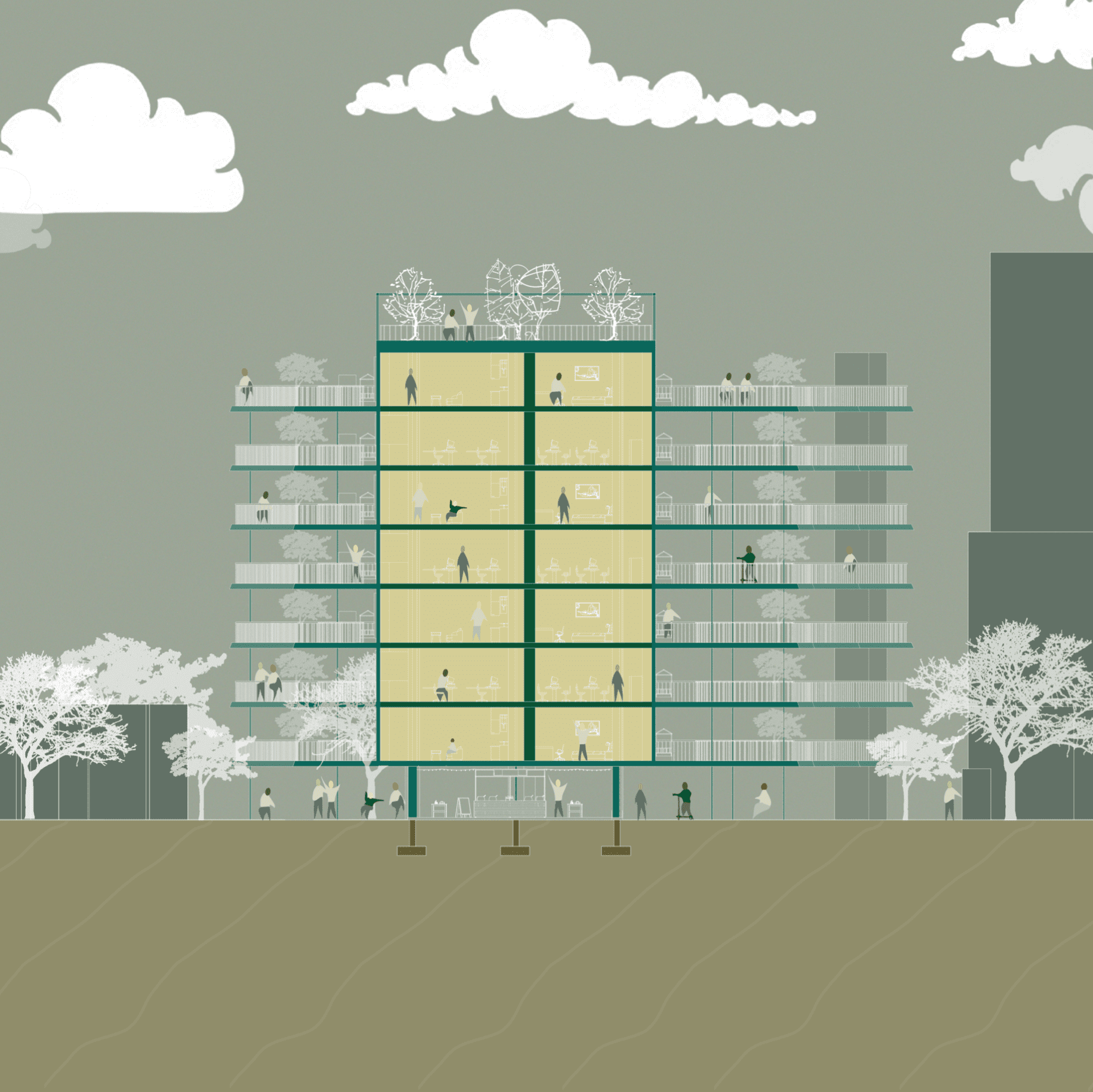
Grow The City recognizes the absence of growing and biodiversity in London and takes advantage of underutilized and disused buildings, embedding growing amongst living and working. Through a regenerative infrastructure, agricultural business sites will be formed through interrogating architecturally and spatially the spaces that are available.
Motivation —
To create a circular economy in the future, there needs to be collaboration and cooperation between industries, working together towards a sustainable future. Food waste accounts for a big amount of total waste produced every year with the main source from prepared food and dairy products. A case for change in response by identifying food waste as the problem and using it as a catalyst to convert them into useful materials.
Strategy —
The key design strategies include the addition of elements to the existing building. As the commercial building stands on its own, the goal is to add value and create a better social environment to live in. The addition of housing blocks provides affordable homes and creates a live/work scenario. Extending the balconies to the current building facilitates better circulation and also turns the area into a destination for users, serving as an urban park within the city.
Impact —
The project aims to create a balance between lifestyle and agriculture. It challenges the typology of whether all housing requires agriculture. As food waste takes up an abundant amount of waste in our system, we can re-use these substances and convert them into useful energy within our city. To be able to grow your own food, or be part of a scheme that allows people to gain ownership and a healthy balanced lifestyle. The addition of green spaces and gardens creates a visible and psychological connection to a community and the fruits of its labour.